School Assistant

An AI admissions office for language schools, course centres, schools and universities that recommends programs, books trial lessons and placement tests, takes applications and documents in the chat, and sends fee installment reminders with payment links.
Overview
School Assistant is the admissions and front office of a language school, course or tutoring centre, private school or university admissions office on WhatsApp, Instagram and web chat. It works around the clock and answers parents, students and applicants in their own language, including voice messages.
You choose the kind of institution once, and the wording, documents and defaults follow it.
For families already enrolled, it answers what is due, sends the payment link, tells them about upcoming exams and events, and passes a parent’s message to the class teacher. Whenever a person is needed, it hands over to your team.
Highlights
- Every applicant, from first question to enrolled. Inquiry, Application, Documents, Assessment, Offer, Enrolled and Lost on one list. New applications go to your admissions staff in turn, and applications nobody has answered in time are marked late.
- Documents collected in the chat. Each program lists what it needs. Photos and PDFs sent in the chat are filed on the application by themselves, you accept or reject each one, and the family is reminded of what is still missing.
- Fees in installments, paid by link. Registration fee first, then monthly installments. Reminders go out before the due date and when it is overdue, with Pay now and Call me.
Install and set up
- Install School Assistant from Settings › MonoStore › Apps, or open the install link app.monochat.ai/apps/wL7gwZkdhT93hMXGA. Without a MonoChat account, the link lets you sign up first and installs the app for you.
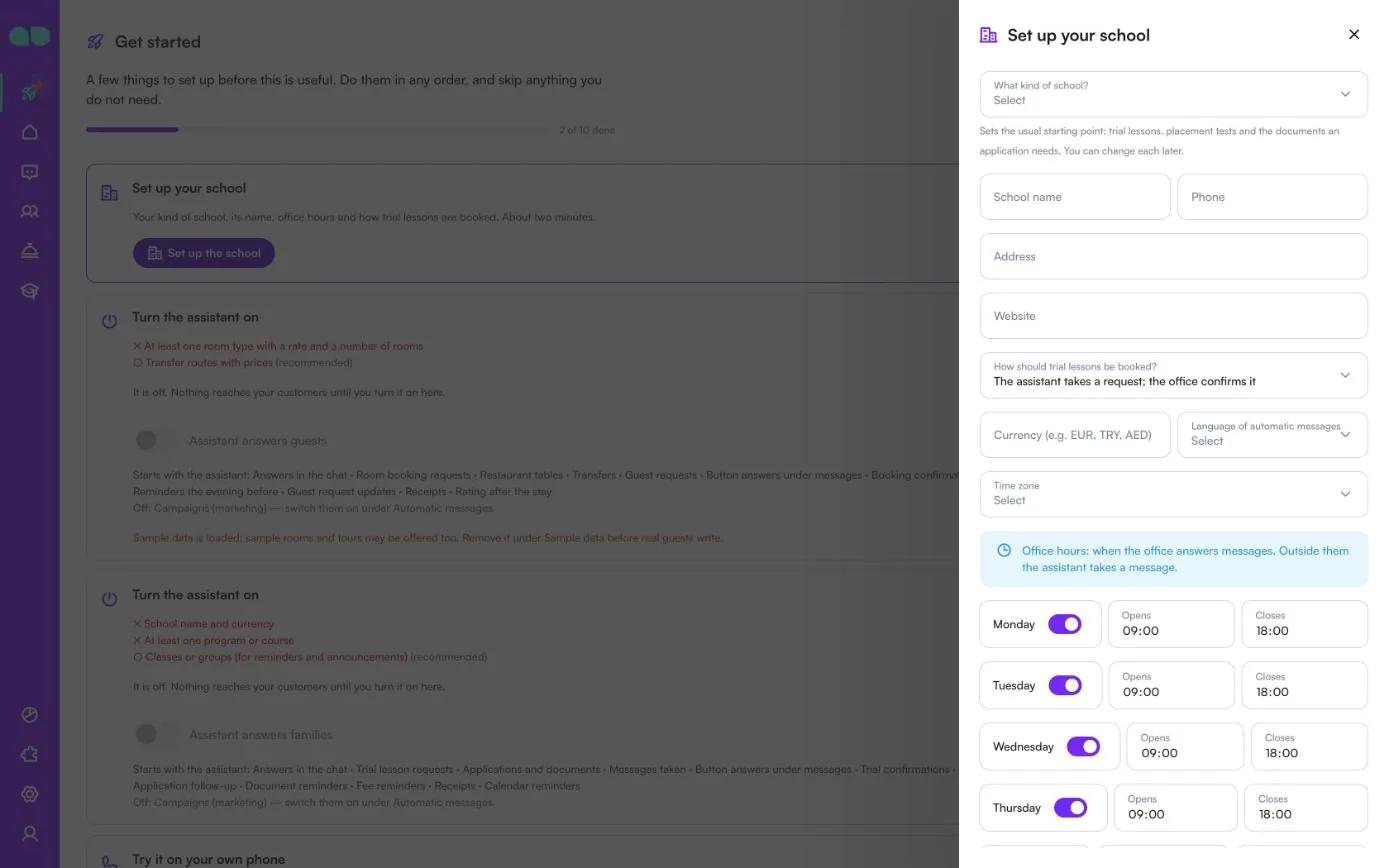
- Open the Get started tab on your MonoChat home page and choose Set up your school, then Set up the school. The form asks for What kind of school? (language school, course or tutoring centre, school (K-12), or university or college admissions; this sets the usual starting point for trial lessons, placement tests and the documents an application needs), the School name, phone, address, website, How should trial lessons be booked? (the assistant takes a request the office confirms, or books at once while there is room), currency, the Language of automatic messages, time zone and your office hours for each day. Tick Also load sample data so I can see it full if you want every screen filled with example records. Click Save and continue.
- Open School › Programs and add your programs with fees, schedules, start dates and the documents each one needs. Add your classes on Groups with their teacher, schedule and room. Check the Admissions, Fees and payments, Parent messages, Automatic messages, How it talks and Handover tabs too.
- Open School desk in the left menu and click the green power button (Turn on) in the header. The Turn the assistant on drawer lists what is still missing and what will start; switch Assistant answers families on and confirm. The badge next to the title changes from Off to On. Only someone who can manage automations in the workspace sees the power button and can turn the assistant on or off.
- Choose Try it on your own phone on the Get started tab and message your own number the way a parent or a student would: ask about a program, book a trial lesson or start an application.
- Each automatic message has its own switch, and WhatsApp templates are written and submitted on your number for you. Nothing goes out in quiet hours or to anyone who said stop.
- Campaigns go out as approved WhatsApp marketing messages, are off by default and leave out people reached in the last 14 days.
Screen by screen
School Assistant lives under School desk in the left menu (the graduation cap icon); its list of screens is headed School. The screenshots below show the app with its sample data loaded.
The header of the list has two shortcut buttons: + opens a new application and the student icon opens a new trial lesson. Next to them are the On / Off badge and the power button. Trial lessons appears in the menu only when trial lessons or placement tests are switched on.
Set up your school
After installing, the Get started tab on your MonoChat home page gets the app’s steps: Set up your school (your kind of school, its name, office hours and how trial lessons are booked; about two minutes), Turn the assistant on and Try it on your own phone. Set up the school opens this form. Each part can be changed later on its own tab.
| Field | What it does |
|---|---|
| What kind of school? | Language school, course or tutoring centre, school (K-12), or university or college admissions. Sets the usual starting point: whether trial lessons and placement tests are on, and which documents an application needs. A K-12 school also starts with notes to teachers switched on. |
| School name, Phone, Address, Website | What the assistant tells families about you. The school name is required. |
| How should trial lessons be booked? | The assistant takes a request; the office confirms it, or The assistant books at once while there is room. |
| Currency (e.g. EUR, TRY, AED) | A three-letter code, used for every fee. Required. |
| Language of automatic messages | The language reminders and WhatsApp templates are written in. Empty uses the workspace’s language. |
| Time zone | Empty uses the workspace’s time zone. |
| Days of the week | Office hours: when the office answers messages. Outside them the assistant takes a message. Switch each day on or off and set Opens and Closes. |
| Also load sample data so I can see it full | Fills every screen with example programs, students and applications. |
Click Save and continue. The next step is shown in a message: add your programs and their fees on the Programs tab.
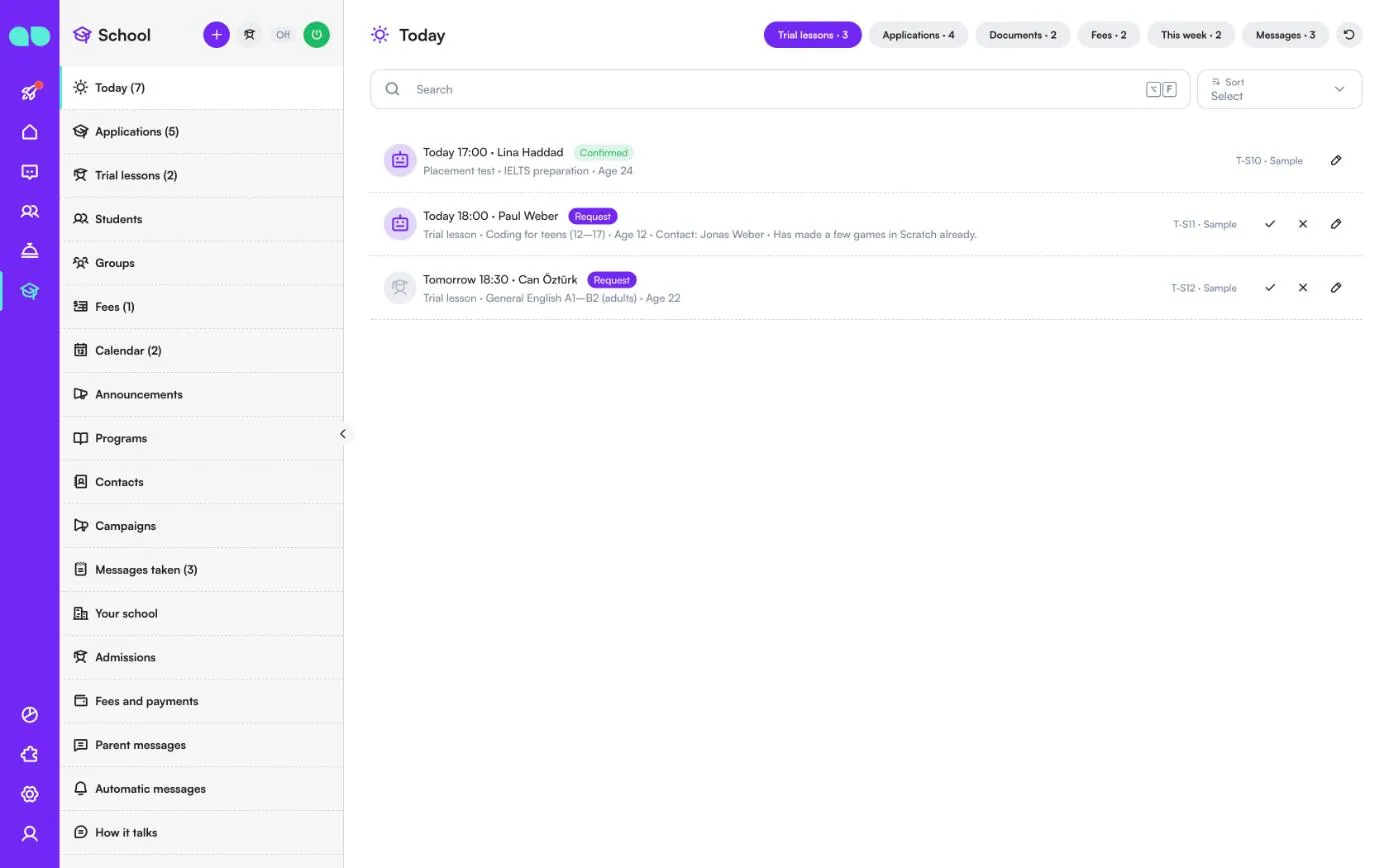
Today
What needs attention today, on one screen. The tabs across the top show how many items each has: Trial lessons (today and tomorrow), Applications (late or waiting), Documents (sent and still to review), Fees (due or overdue), This week (exams, deadlines and events coming up) and Messages. The count next to Today in the menu adds up today’s trials, late applications, overdue fees and open messages.
A trial row shows the time, the student, the status, whether it is a trial lesson or a placement test, the program, the age, the contact and any note from the chat. A robot icon means the assistant booked it. A request has a check to confirm it and a cross to decline it; the pencil opens the record. On the Fees tab you can send the payment request straight from the row.
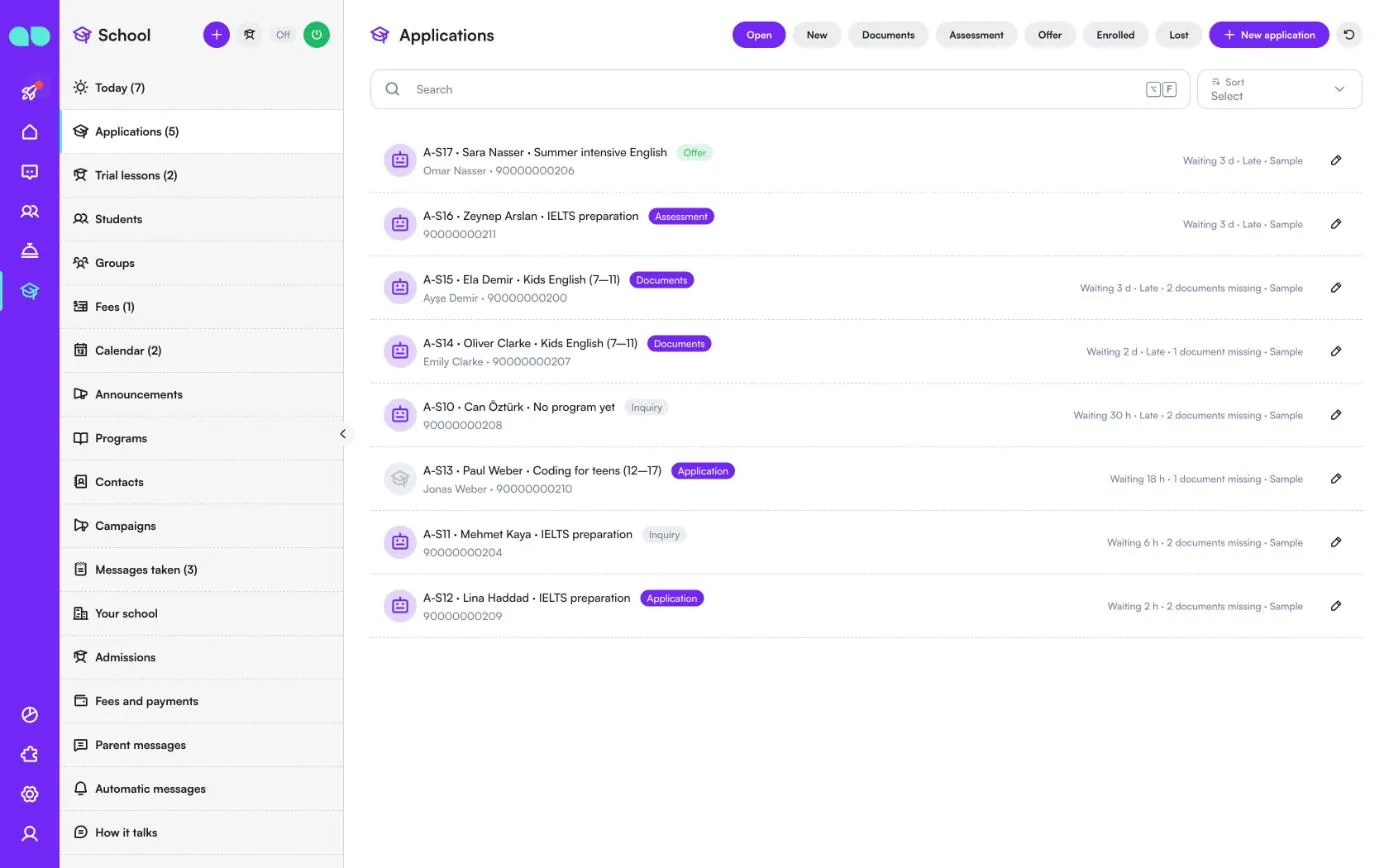
Applications
Every applicant, from the first question to enrolled. Filter with Open, New, Documents, Assessment, Offer, Enrolled and Lost, search and sort, and add one with New application.
A row shows the application code, the student, the program (or No program yet), the stage (Inquiry, Application, Documents, Assessment, Offer, Enrolled or Lost), the contact and phone. On the right you see how long it has been waiting, Late when nobody has answered within Answer within (hours), and how many documents are still missing. The count next to Applications in the menu is new applications plus open offers.
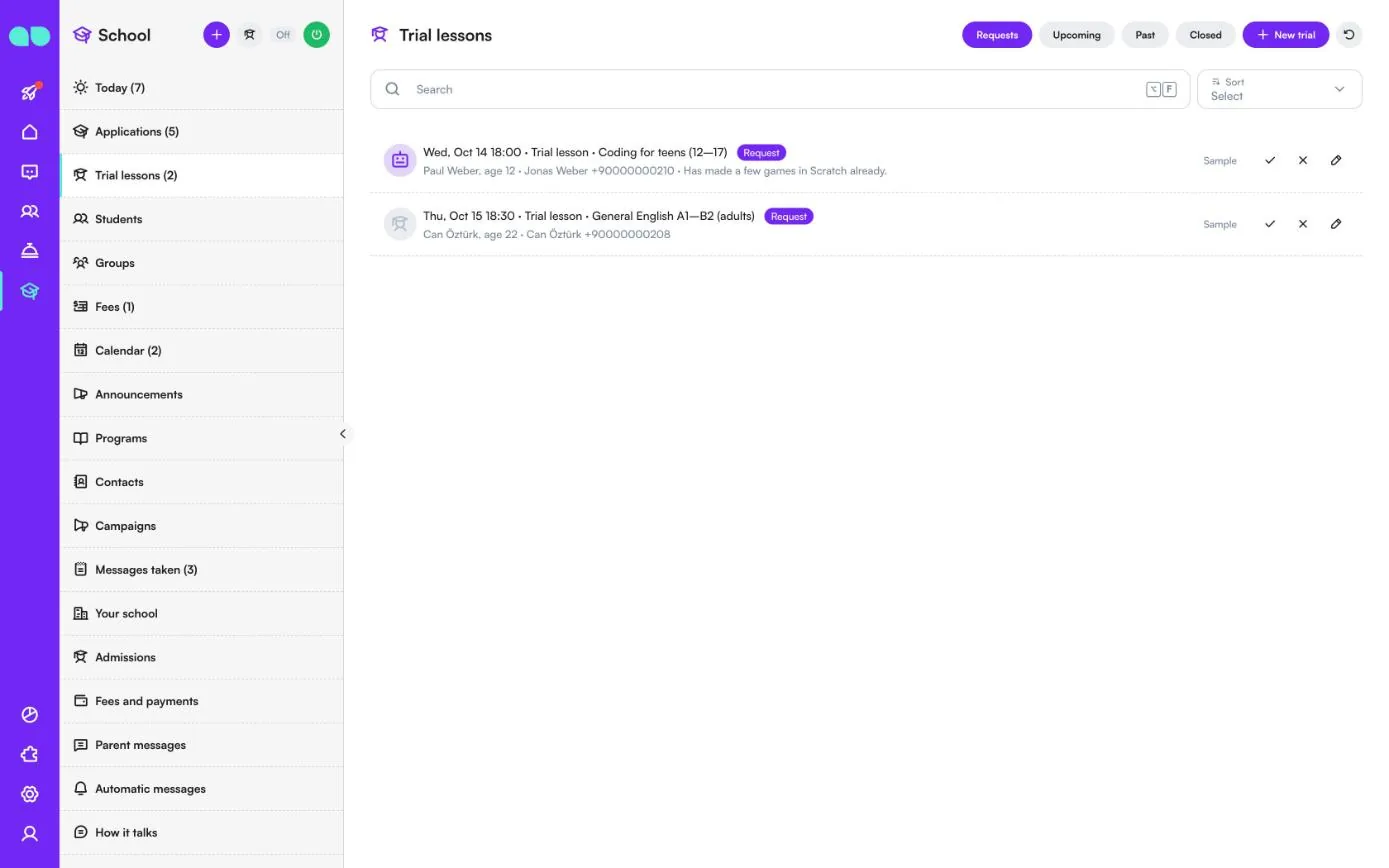
Trial lessons
Trial lessons and placement tests booked in the chat or by the office. Filter with Requests, Upcoming, Past and Closed, and add one with New trial.
A row shows the date and time, whether it is a trial lesson or a placement test, the program, the status, the student and age, the contact and phone, and any note. A request has a check to confirm it and a cross to decline it; when declined, the contact is told that the time cannot be offered. After the lesson you mark it Done or No-show and record the outcome (Interested, Thinking or Not interested). The count next to Trial lessons in the menu is the number of requests waiting.
Students
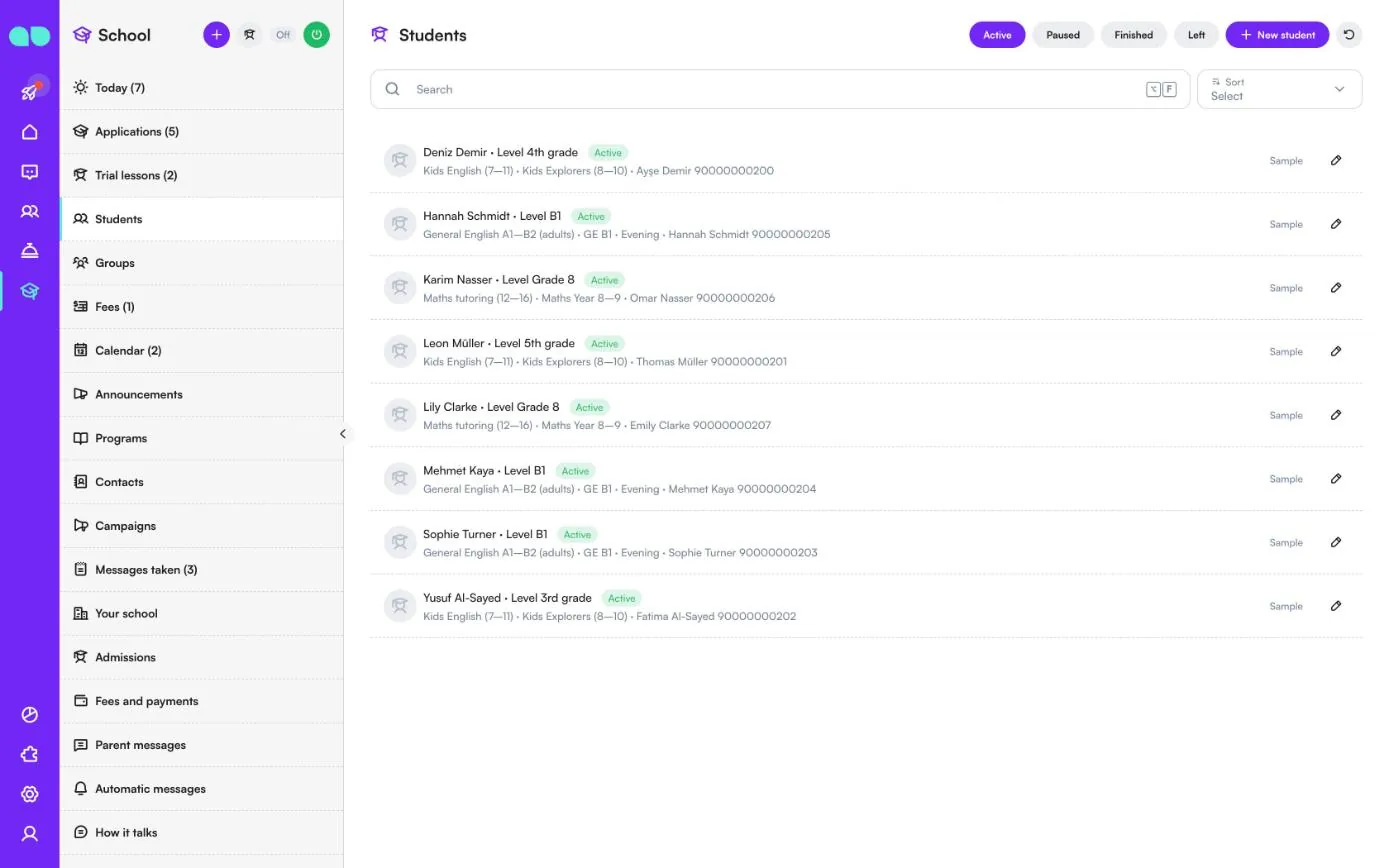
Students appear here when they enrol, and you can also add them yourself with New student. Filter with Active, Paused, Finished and Left. A row shows the student, their level or grade, the status, the program and group, and the contact who gets the messages (a parent, or the student themselves).
Groups
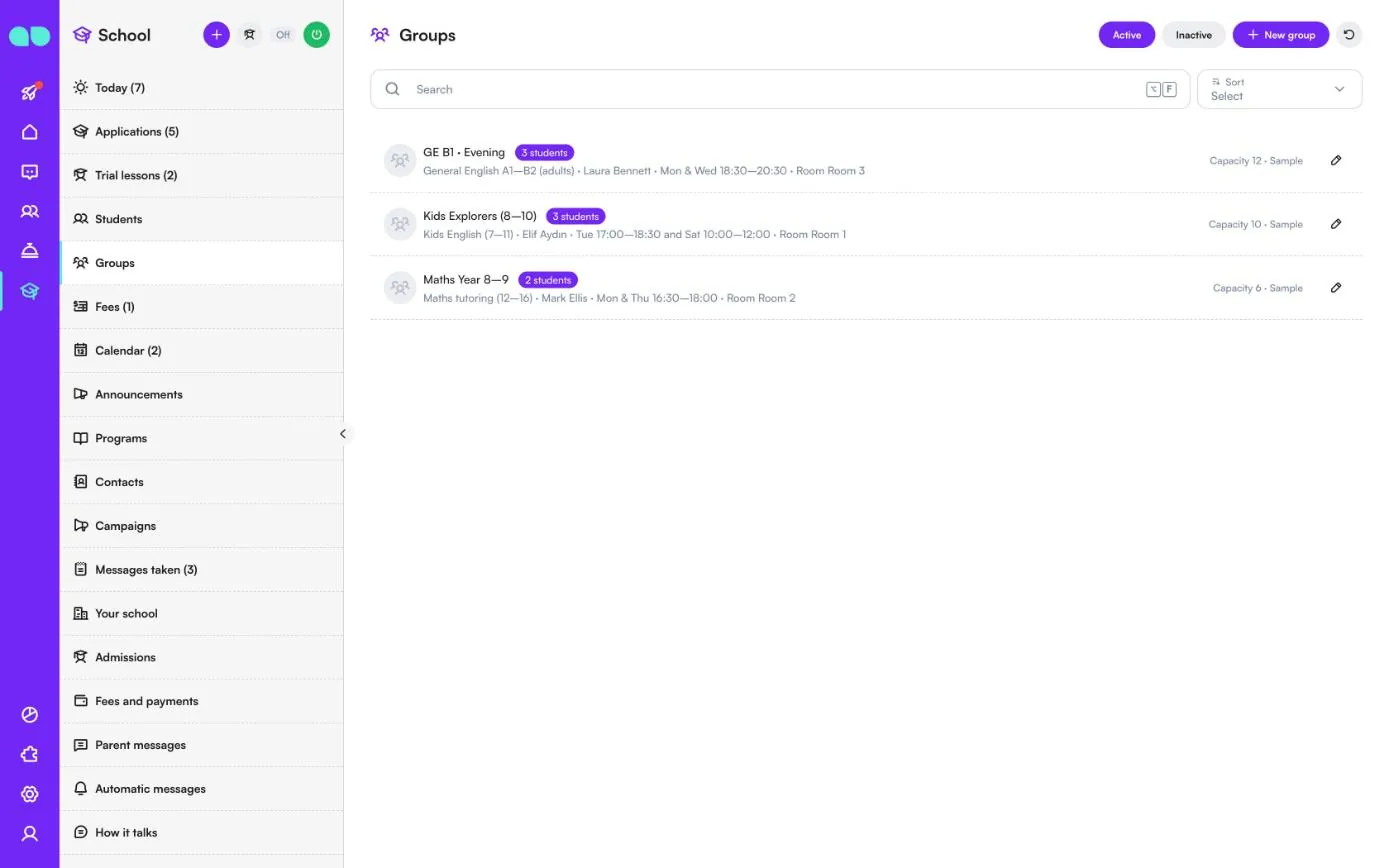
Your classes. Filter with Active and Inactive, and add one with New group. A row shows the group name, how many students are in it, the program, the teacher, the schedule and the room, with the capacity on the right.
The teacher set on a group gets the notes parents leave for the teacher (see Parent messages). From a group you can also message its families or add a calendar event for it.
Fees
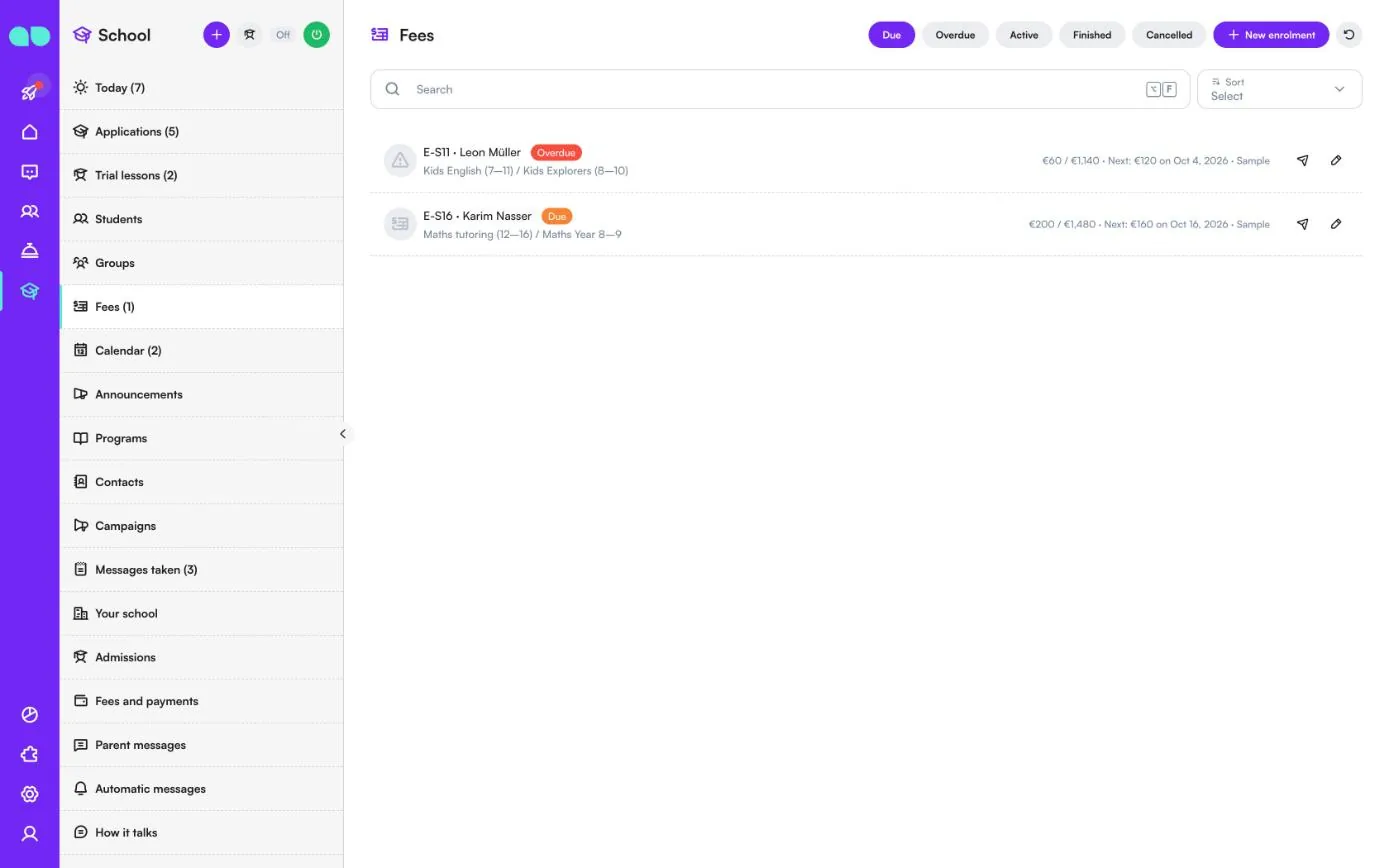
Enrolments and their installment plans. Filter with Due, Overdue, Active, Finished and Cancelled, and add one with New enrolment. The count next to Fees in the menu is the number overdue.
A row shows the enrolment code, the student, the status, the program and group, what is paid of the total, and the next installment with its date. The paper plane sends the payment request to the contact; the pencil opens the enrolment, where you can also record a payment taken at the office in cash, by card or by bank transfer. Sample enrolments never get payment messages.
Calendar
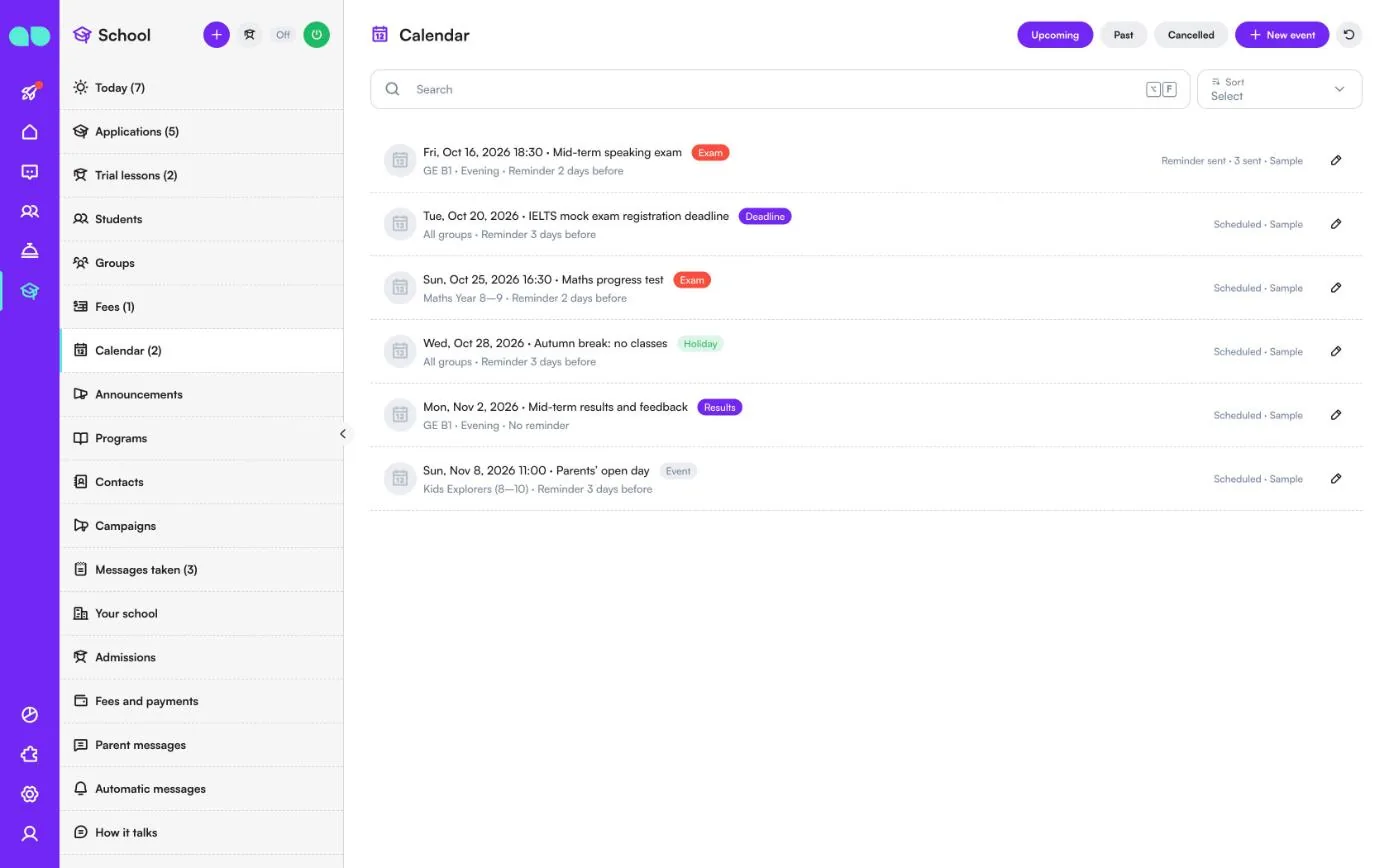
Exams, deadlines, holidays, results and events. Filter with Upcoming, Past and Cancelled, and add one with New event. A row shows the date and time, the title, the kind (Exam, Deadline, Holiday, Results or Event), the group it is for (or All groups) and when the reminder goes out. On the right you see whether it is Scheduled or the Reminder sent, and to how many people. Families of the groups concerned are reminded a set number of days before when Calendar reminders is on.
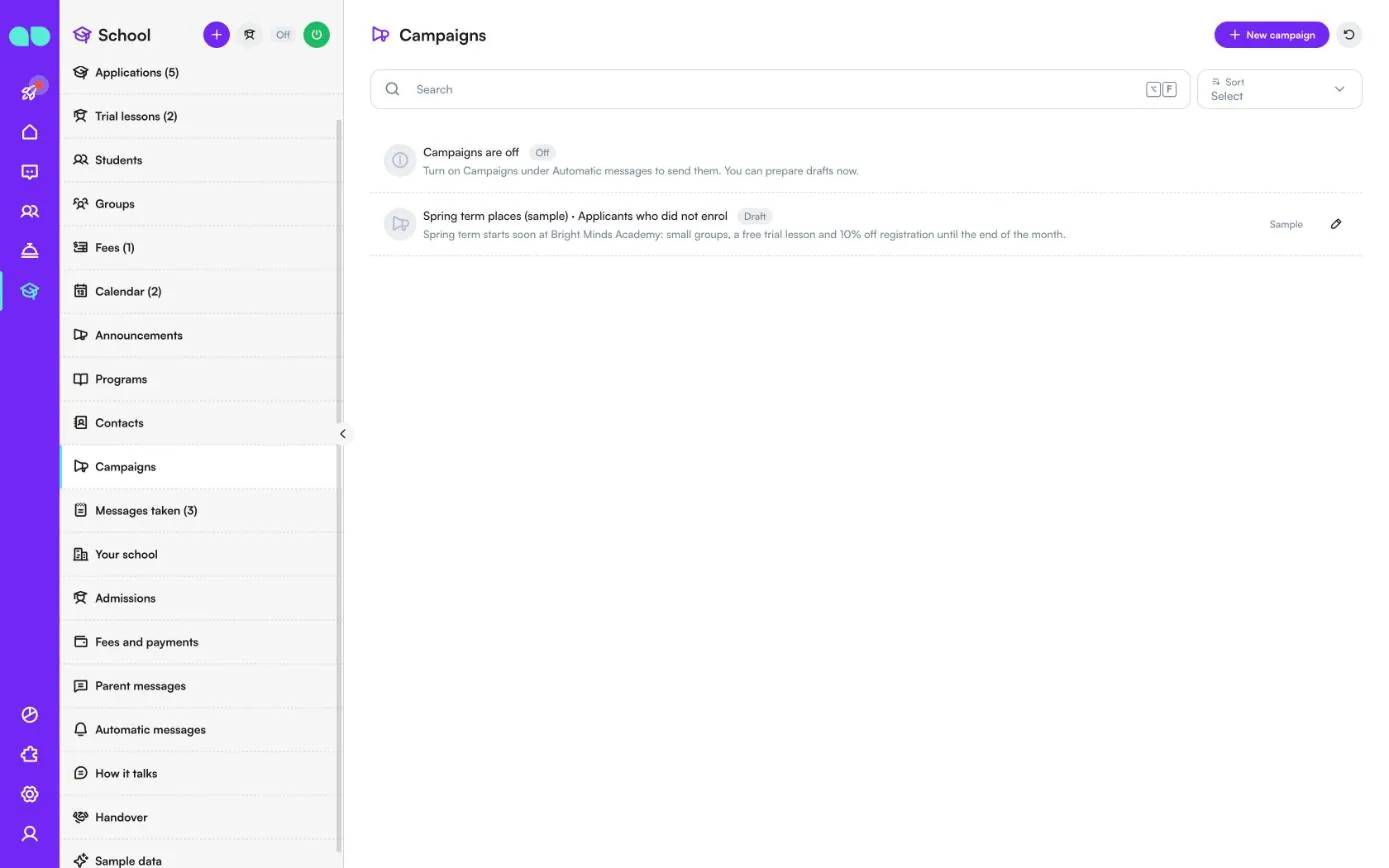
Announcements
A message to the families of one or more groups: a room change, a party, a closed day. Filter with Drafts, Sending, Sent and Stopped, and add one with New announcement. A row shows the title, the status, the groups and the message. When you send it, the contacts are fixed and messages go out a few dozen at a time, outside quiet hours; people who opted out and sample data are never messaged. A sample announcement cannot be sent.
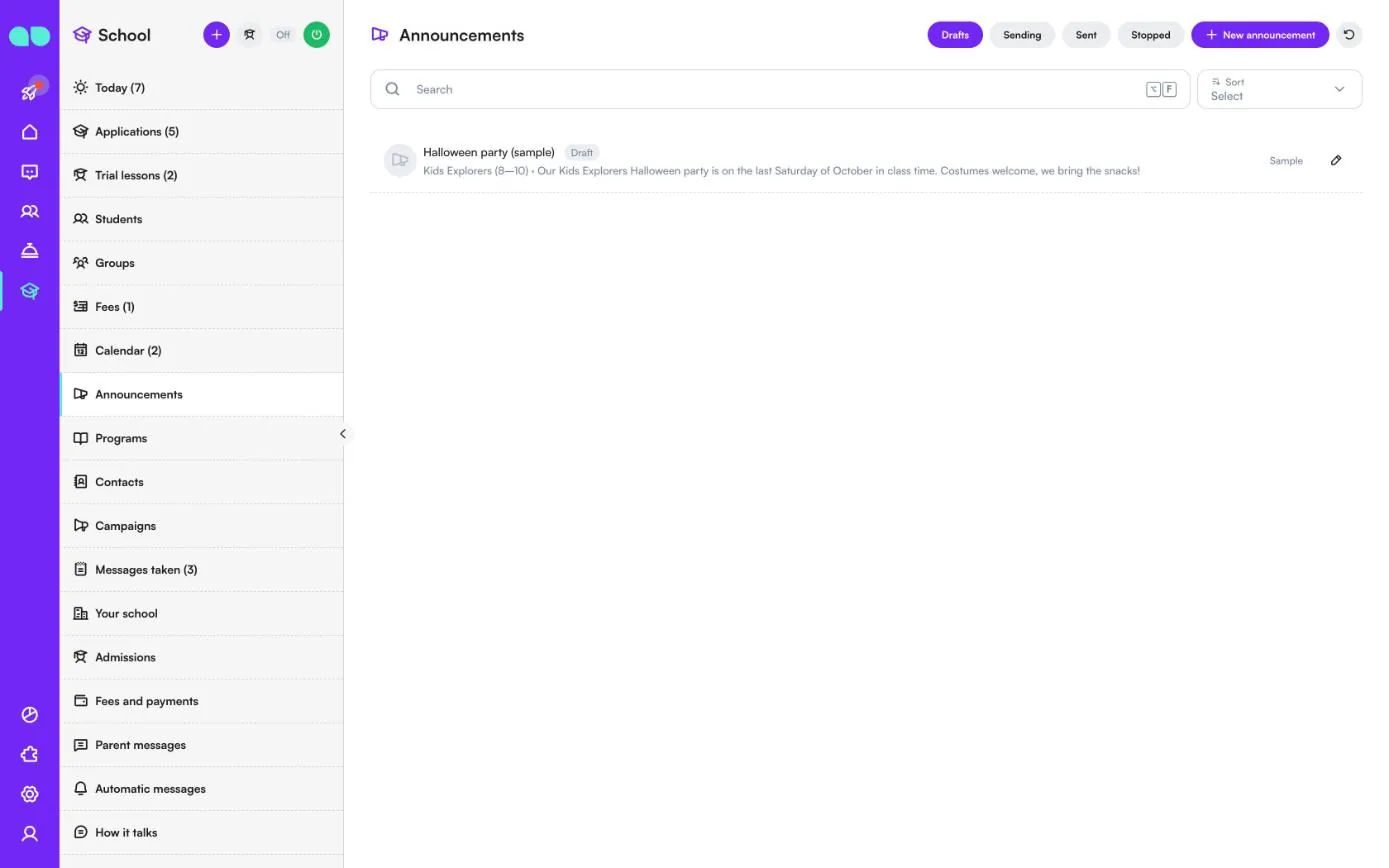
Programs
The programs and courses you offer; the assistant only talks about what is here. Filter with Active and Inactive, and add one with New program. A row shows the name and level, the subject, the ages, the format (In person, Online or Hybrid), and on the right the fee (per course, per month, per term or per year) and whether it offers a trial lesson.
A program also holds its description, schedule, duration, start dates, registration fee, the most installments allowed, places, requirements, the documents an application needs, photos (the first is the card photo) and keywords people may use for it.
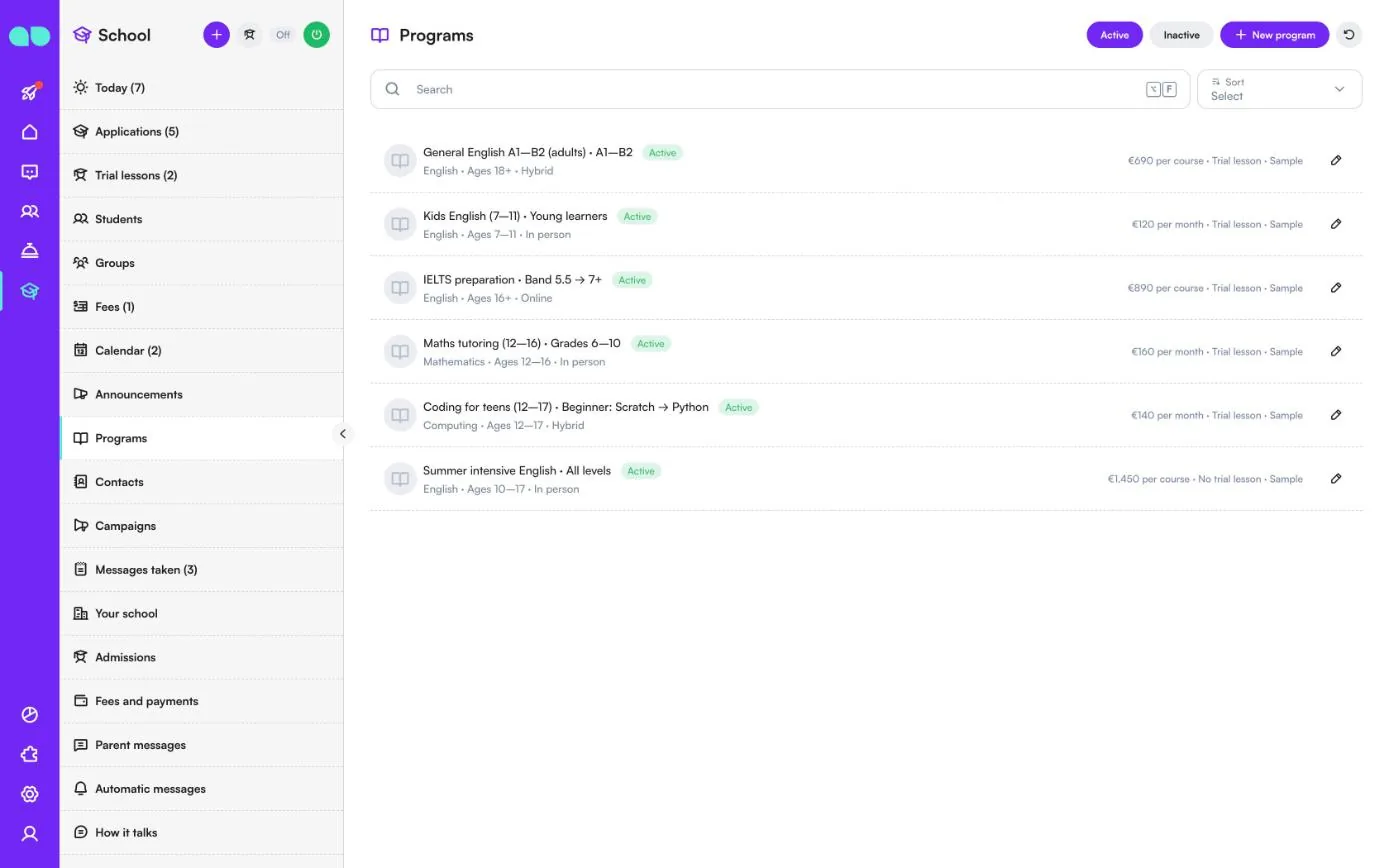
Contacts
Everyone who writes to you on WhatsApp, Instagram or your website chat. Filter with All, Guardians, Students and Prospects, and add one with New contact. A row shows the name, phone, role (Guardian, Student or Prospect), language and where they came from (Website, Referral, Ad, Walk-in, Education portal, WhatsApp or Instagram), with the number of linked students on the right. Open a contact to see their students, open applications, upcoming trials and fees to pay.
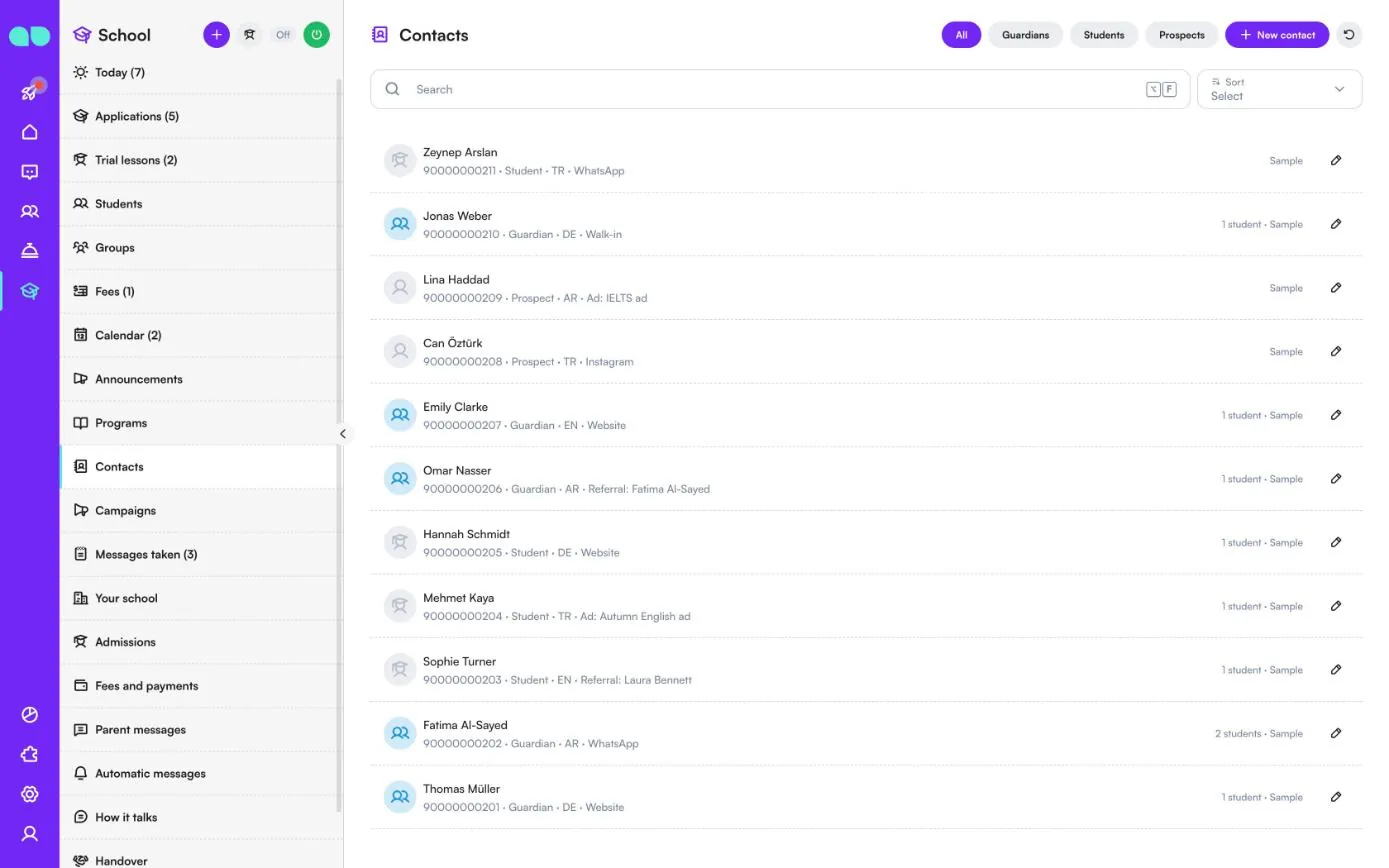
Campaigns
Offers to Past students, Applicants who did not enrol, people with a Trial lesson, no enrolment or All contacts. New campaign prepares one. While Campaigns (marketing) is off under Automatic messages, a Campaigns are off row says so and you can only prepare drafts.
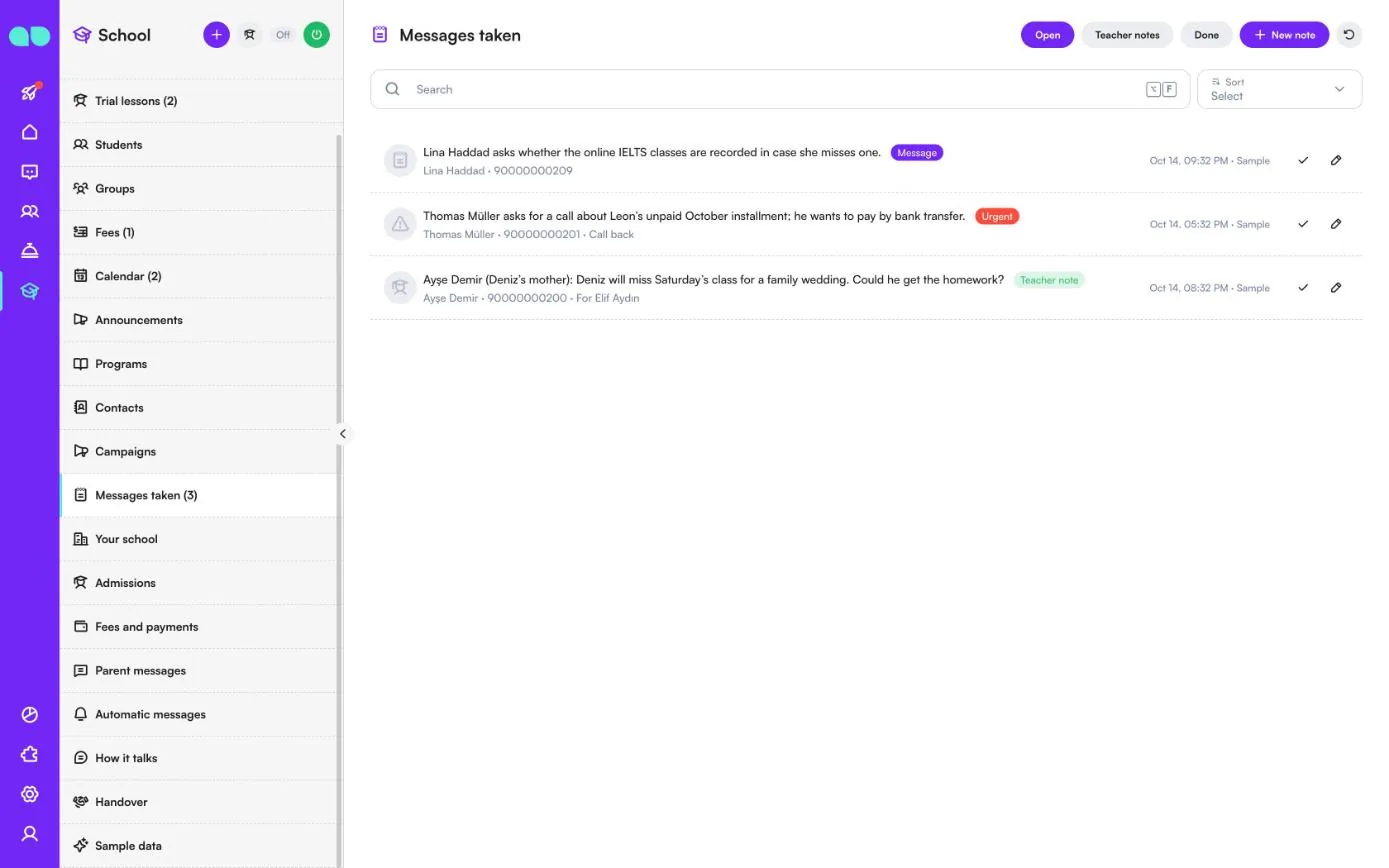
Messages taken
When the assistant cannot help someone, or a parent leaves a message for a teacher, it is written down here. Filter with Open, Teacher notes and Done, and add one with New note. A row shows the message, the contact and phone, and its kind: Message, Urgent, Call back or Teacher note (with the teacher it is for). Click the check to mark it done, or reopen it later.
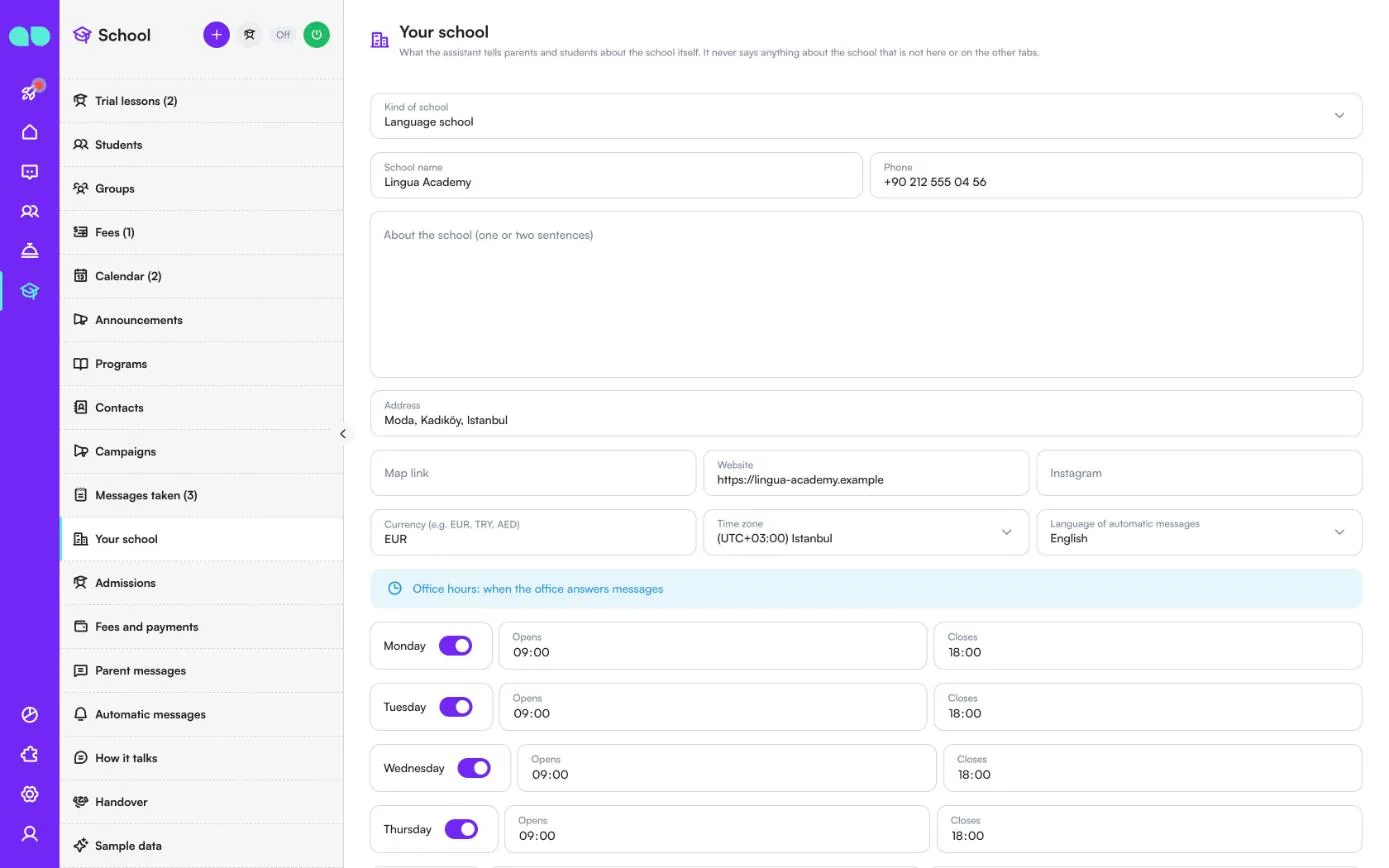
Your school
What the assistant tells parents and students about the school itself. It never says anything about the school that is not here or on the other tabs.
| Field | What it does |
|---|---|
| Kind of school | Language school, course or tutoring centre, school (K-12), or university or college admissions. |
| School name, Phone, Address | Your contact details. |
| About the school (one or two sentences) | A short description the assistant can use. |
| Map link, Website, Instagram | Links the assistant can share. |
| Currency, Time zone, Language of automatic messages | Used for fees, times and the automatic messages. |
| Office hours, Closed on (holidays) | When the office answers messages; holidays one date per line (YYYY-MM-DD). |
| School rules and policies | Attendance, absences, refunds, make-up lessons, pick-up. |
| Campus and facilities | Classrooms, transport, meals, uniforms, parking. The assistant answers questions about the place from this text. |
| Other questions and answers | One pair per line: Q: … / A: … |
| Review page link | Where happy parents and students are asked to leave a review, for example your Google link. |
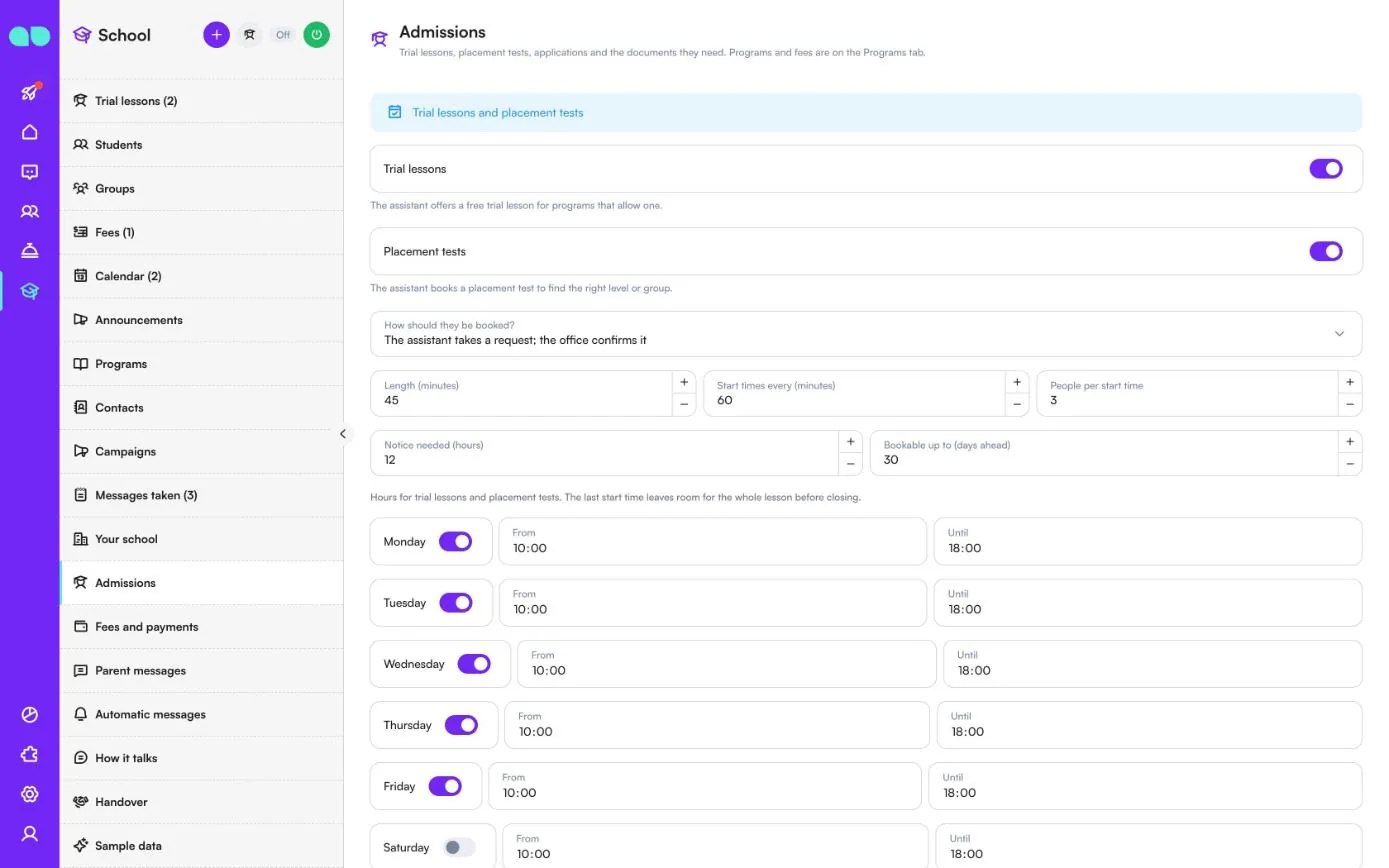
Admissions
Trial lessons, placement tests, applications and the documents they need. Programs and fees are on the Programs tab.
| Field | What it does |
|---|---|
| Trial lessons | The assistant offers a free trial lesson for programs that allow one. |
| Placement tests | The assistant books a placement test to find the right level or group. |
| How should they be booked? | The assistant takes a request; the office confirms it, or The assistant books at once while there is room. |
| Length (minutes), Start times every (minutes), People per start time | How long a lesson takes, how often one can start and how many people fit. |
| Notice needed (hours), Bookable up to (days ahead) | How late and how far ahead a trial can be booked. |
| Days of the week | From and Until for trial lessons and placement tests. The last start time leaves room for the whole lesson before closing. |
| Answer within (hours) | Older applications are marked late on the desk. |
| Follow up after (days) | When an application has not moved, the family gets a follow-up. |
| Remind about documents every (days) | At most two reminders. |
| Admissions staff who get new applications in turn | New applications are assigned to them one after the other. Empty: nobody is assigned automatically. |
| Documents for an application | Each document type with an Asked for switch. The ones switched on are asked for in every application; a program can ask for fewer. Add document type adds your own, for example a vaccination record. |
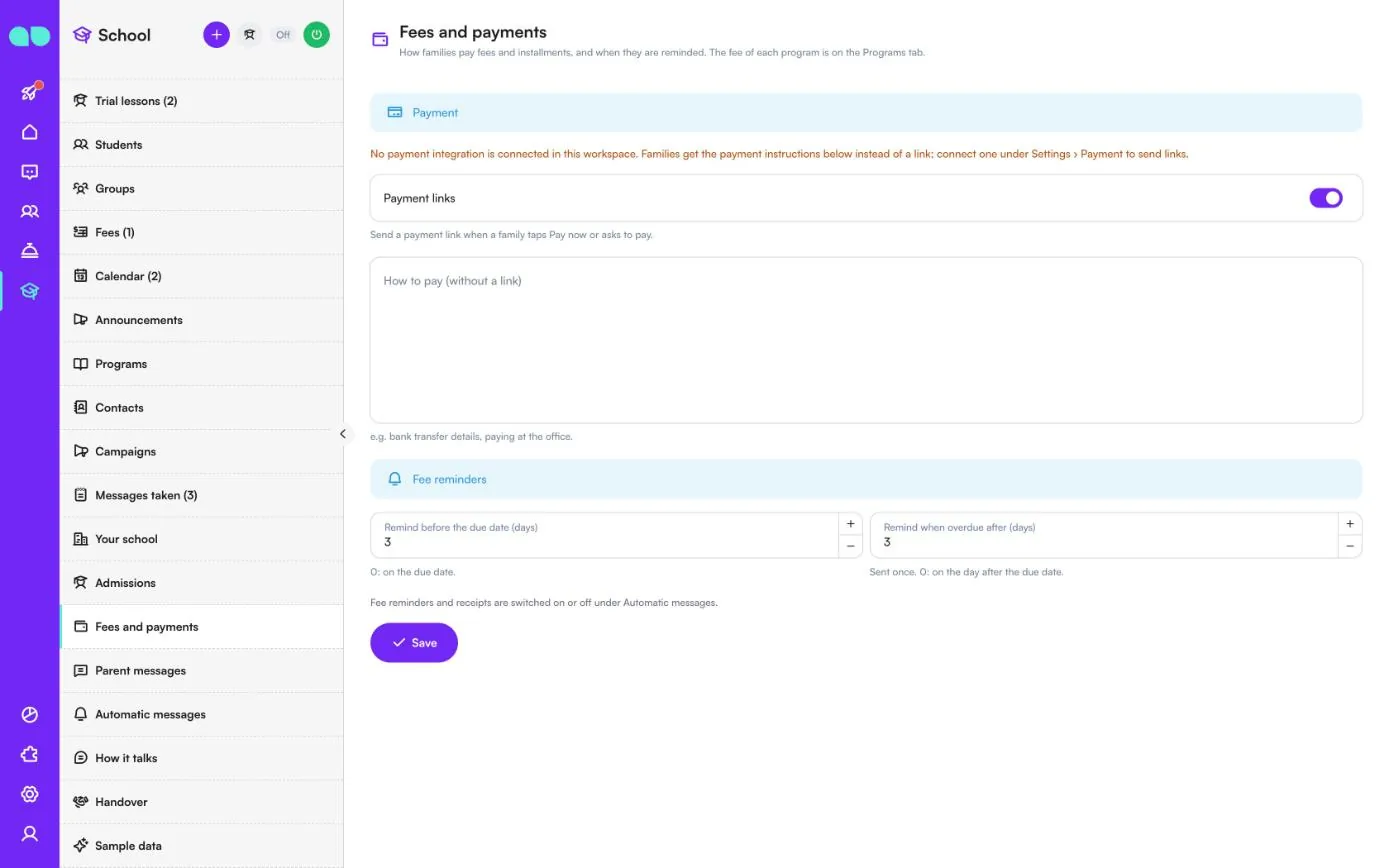
Fees and payments
How families pay fees and installments, and when they are reminded. The fee of each program is on the Programs tab.
- Payment links: send a payment link when a family taps Pay now or asks to pay. With a payment integration, payments are recorded by themselves. Without one, the screen says so, and families get How to pay (without a link) instead, for example bank transfer details or paying at the office. Connect one under Settings › Payment.
- Remind before the due date (days): 0 sends the reminder on the due date.
- Remind when overdue after (days): sent once; 0 means the day after the due date.
Fee reminders and receipts are switched on or off under Automatic messages. Click Save.
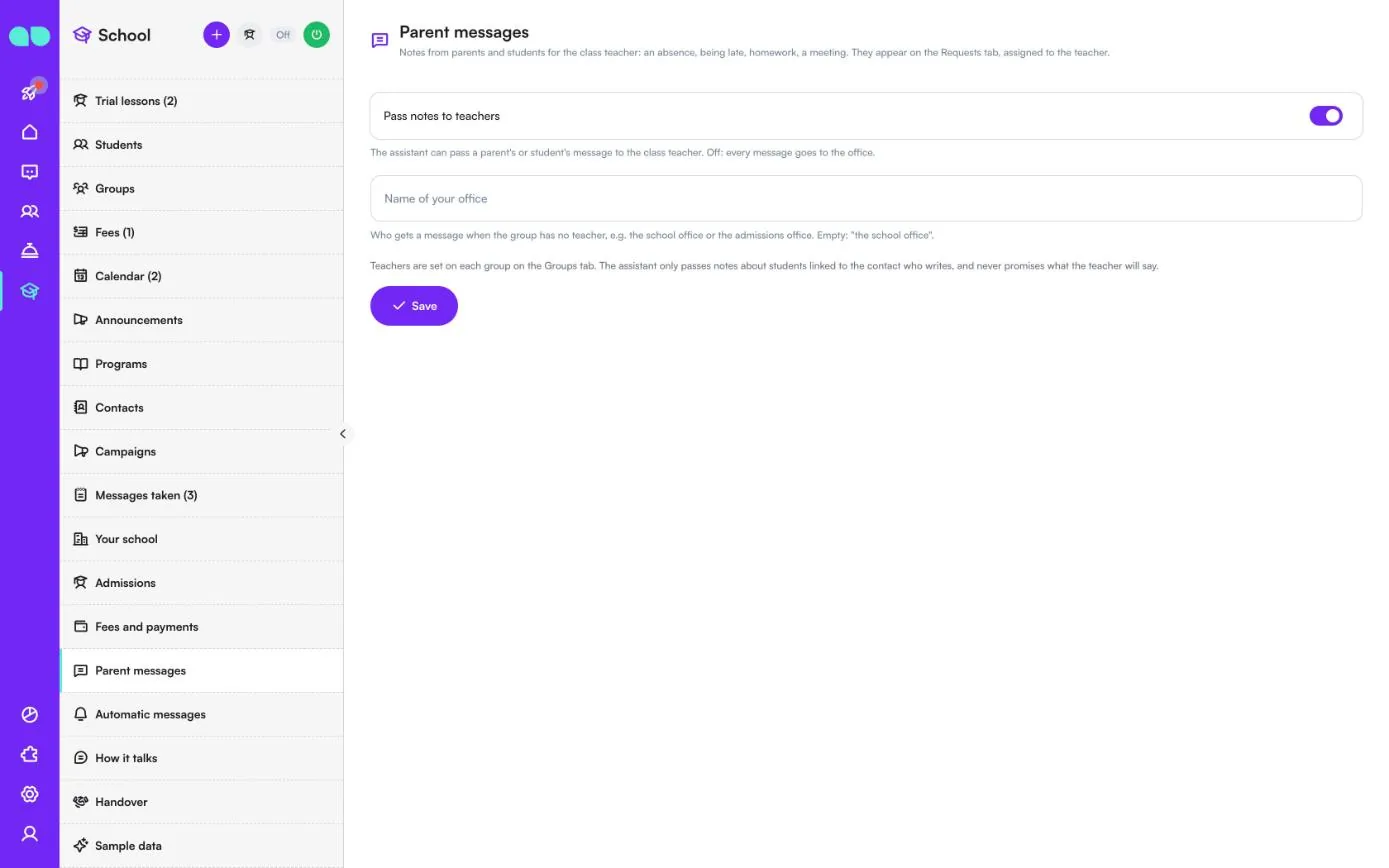
Parent messages
Notes from parents and students for the class teacher: an absence, being late, homework, a meeting. They appear on Messages taken, assigned to the teacher.
- Pass notes to teachers: the assistant can pass a parent’s or student’s message to the class teacher. Off: every message goes to the office.
- Name of your office: who gets a message when the group has no teacher, for example the school office or the admissions office. Empty: “the school office”.
Teachers are set on each group on the Groups tab. The assistant only passes notes about students linked to the contact who writes, and never promises what the teacher will say.
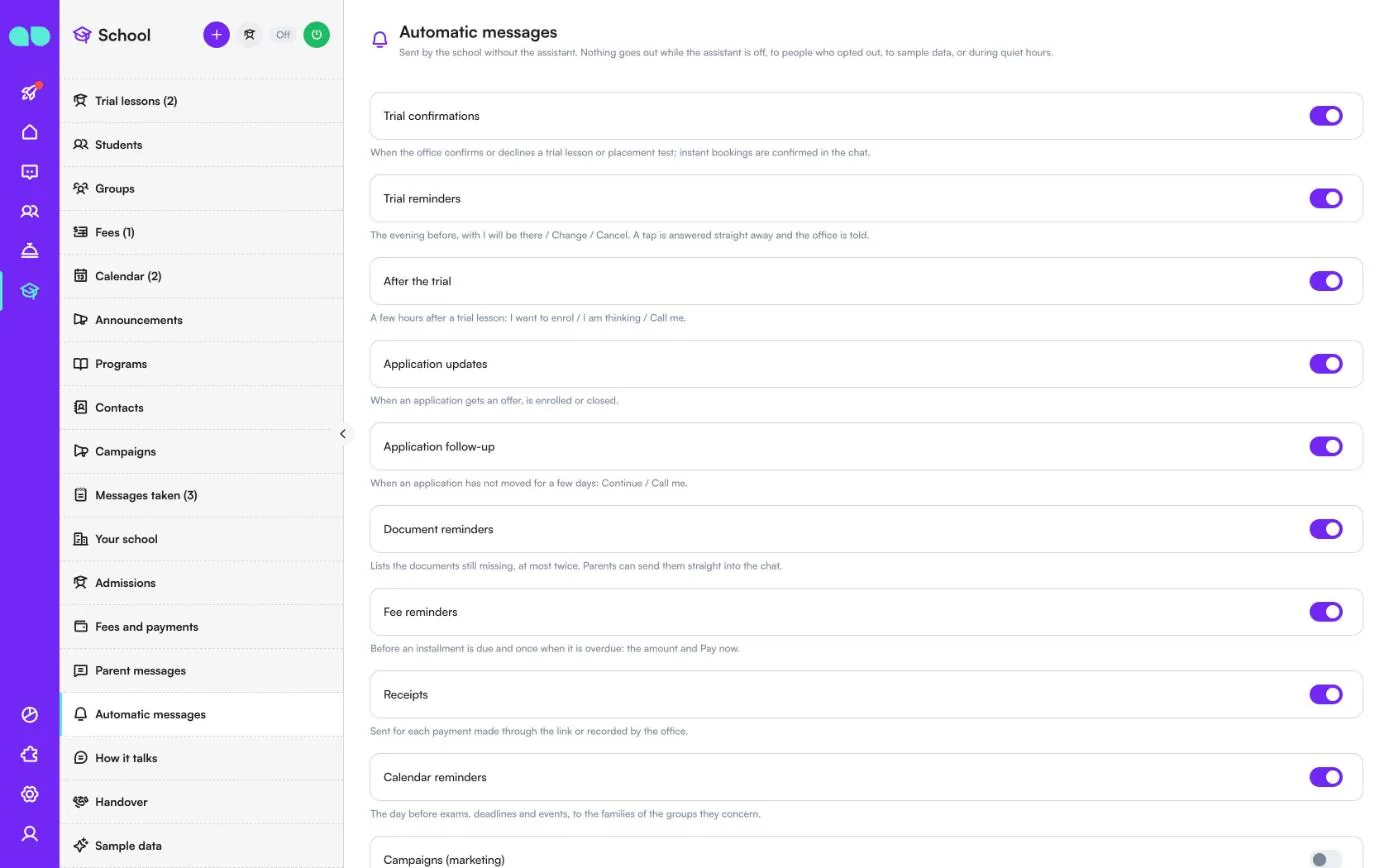
Automatic messages
Messages sent by the school without the assistant. Nothing goes out while the assistant is off, to people who opted out, to sample data, or during quiet hours.
| Message | When it goes out |
|---|---|
| Trial confirmations | When the office confirms or declines a trial lesson or placement test; instant bookings are confirmed in the chat. |
| Trial reminders | The evening before, with I will be there, Change and Cancel. A tap is answered straight away and the office is told. |
| After the trial | A few hours after a trial lesson: I want to enrol, I am thinking and Call me. |
| Application updates | When an application gets an offer, is enrolled or closed. |
| Application follow-up | When an application has not moved for a few days: Continue and Call me. |
| Document reminders | Lists the documents still missing, at most twice. Parents can send them straight into the chat. |
| Fee reminders | Before an installment is due and once when it is overdue: the amount and Pay now. |
| Receipts | For each payment made through the link or recorded by the office. |
| Calendar reminders | The day before exams, deadlines and events, to the families of the groups they concern. |
| Campaigns (marketing) | Lets you send offers to past students and people who asked. Off by default, never to people who opted out. |
Below the switches you set Evening reminders at, After-trial message (hours later), and Quiet from and Quiet until. The WhatsApp templates section shows the status of each template on your number; Submit missing templates writes and submits the ones still missing, in the language of automatic messages.
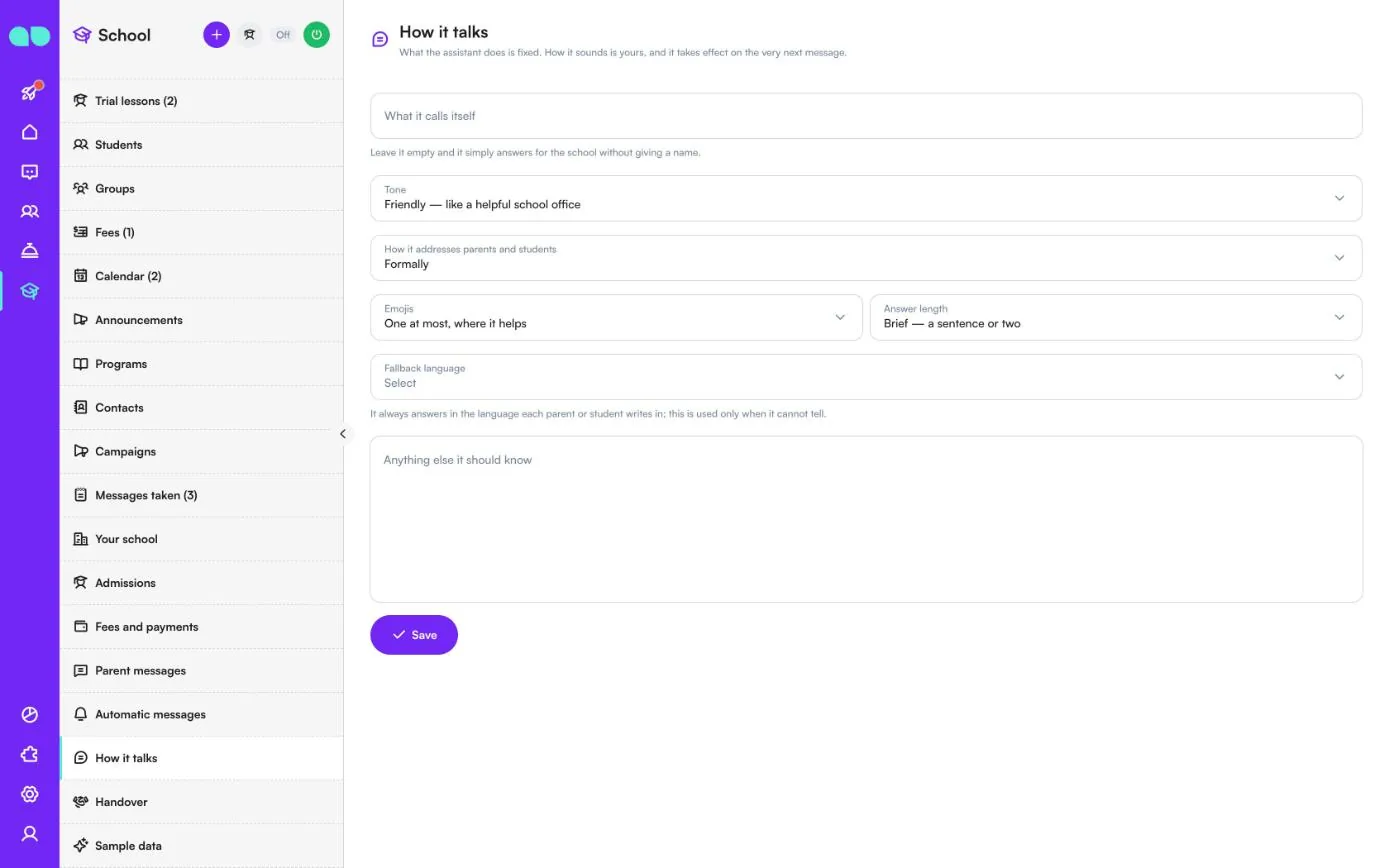
How it talks
What the assistant does is fixed; how it sounds is yours, and a change takes effect on the very next message.
| Field | What it does |
|---|---|
| What it calls itself | A name for the assistant. Leave it empty and it simply answers for the school without giving a name. |
| Tone | Professional, Friendly (like a helpful school office), Warm or Direct. |
| How it addresses parents and students | Formally or Casually, by first name. |
| Emojis | None, one at most where it helps, or freely. |
| Answer length | Brief, balanced or detailed. |
| Fallback language | It always answers in the language each parent or student writes in; this is used only when it cannot tell. |
| Anything else it should know | Added to its instructions as written: school rules, things never to promise (a place, a grade, a discount). It cannot override the rule that it does not invent facts. |
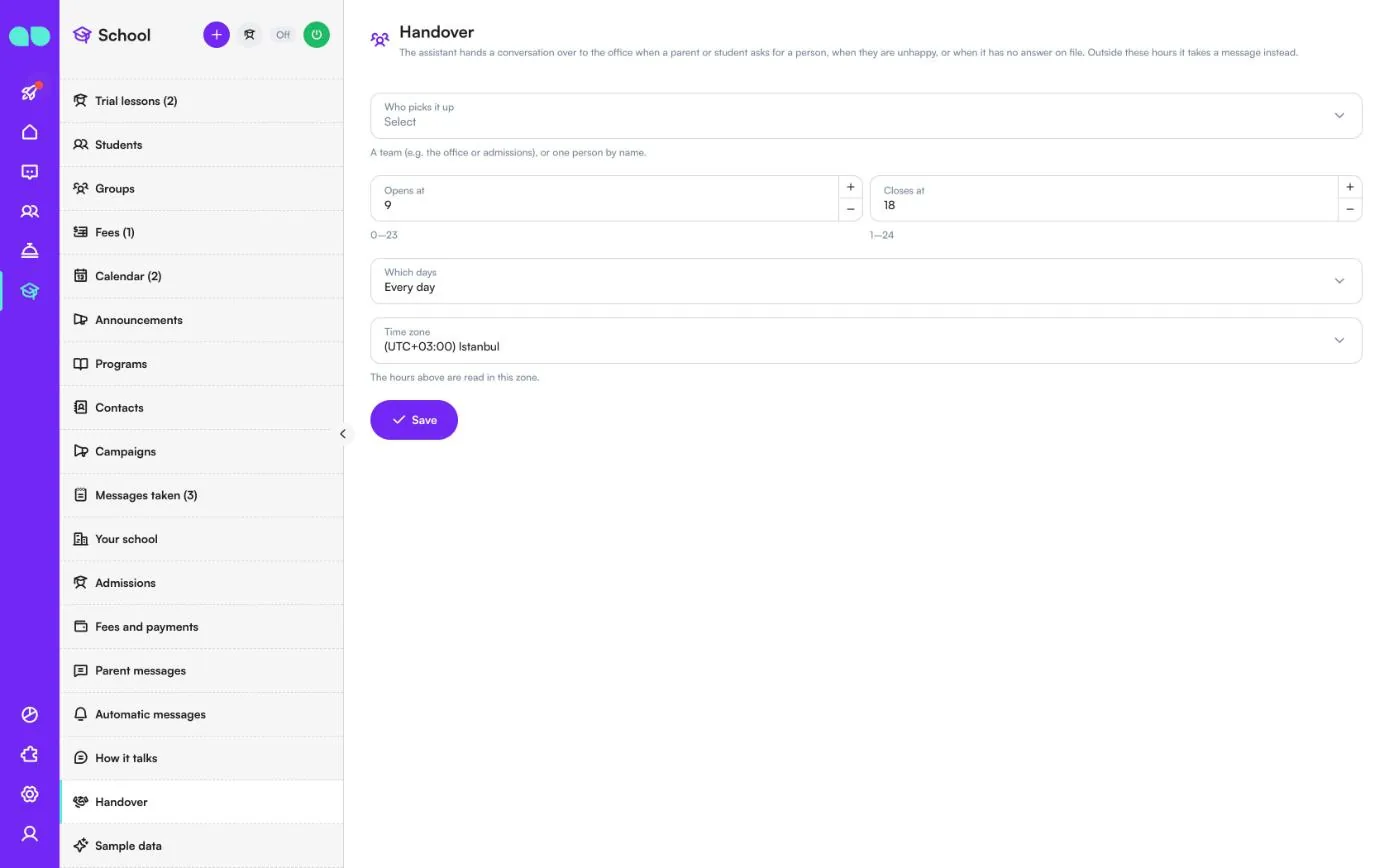
Handover
When a parent or student asks for a person, is unhappy, or asks something the assistant has no answer for, it hands the conversation over to the office. Choose Who picks it up (a team such as the office or admissions, one person by name, or nobody), the hours with Opens at (0–23) and Closes at (1–24), Which days (every day or weekdays only) and the Time zone the hours are read in. Outside these hours it takes a message instead. Click Save.
Sample data
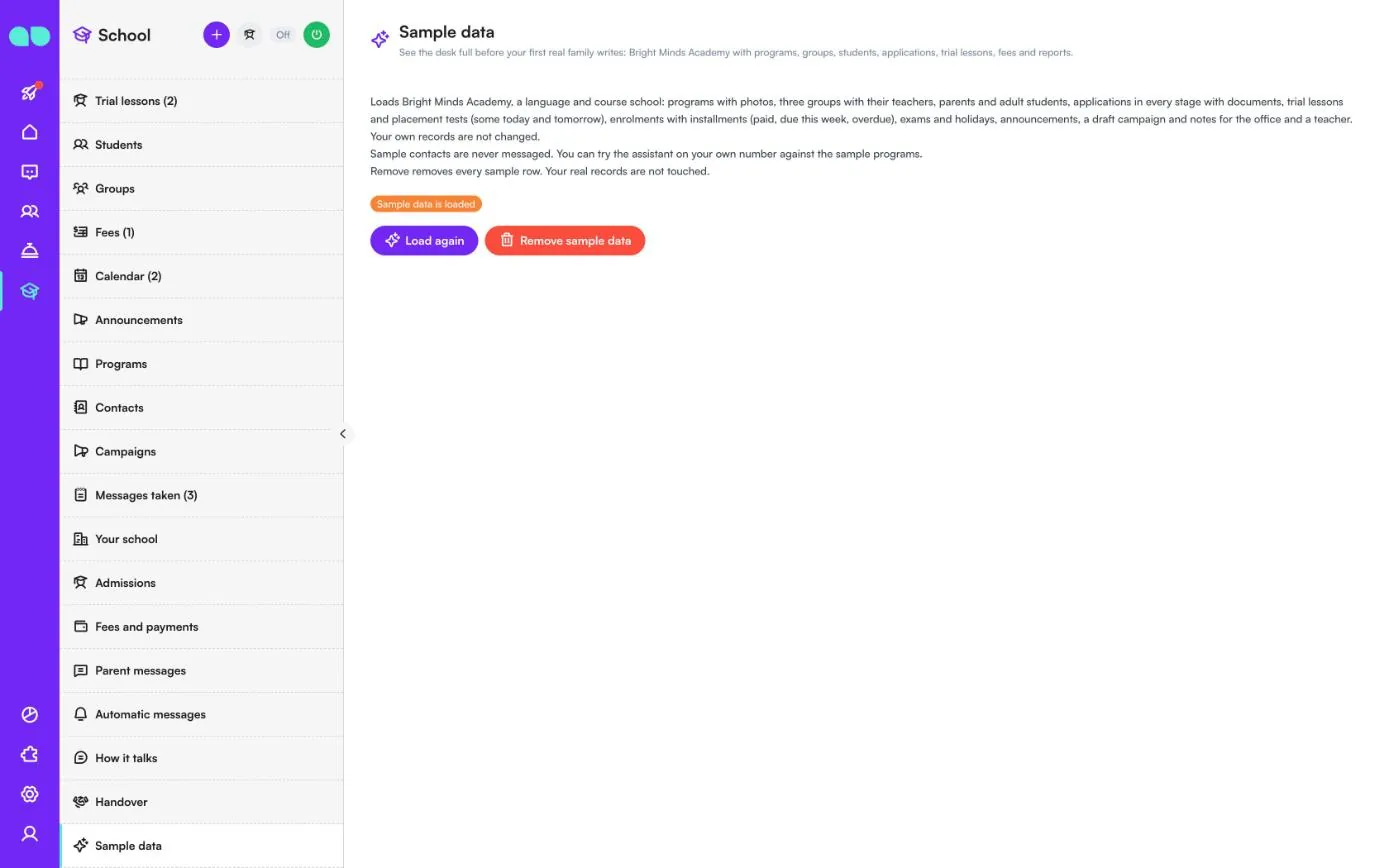
Shows whether sample data is loaded. It loads a sample language and course school: programs with photos, three groups with their teachers, parents and adult students, applications in every stage with documents, trial lessons and placement tests (some today and tomorrow), enrolments with installments (paid, due this week, overdue), exams and holidays, announcements, a draft campaign and notes for the office and a teacher. Your own records are not changed.
Sample contacts are never messaged, but you can try the assistant on your own number against the sample programs. Load again reloads it, and Remove sample data removes every sample row; your real records are not touched. Remove it before real families write.
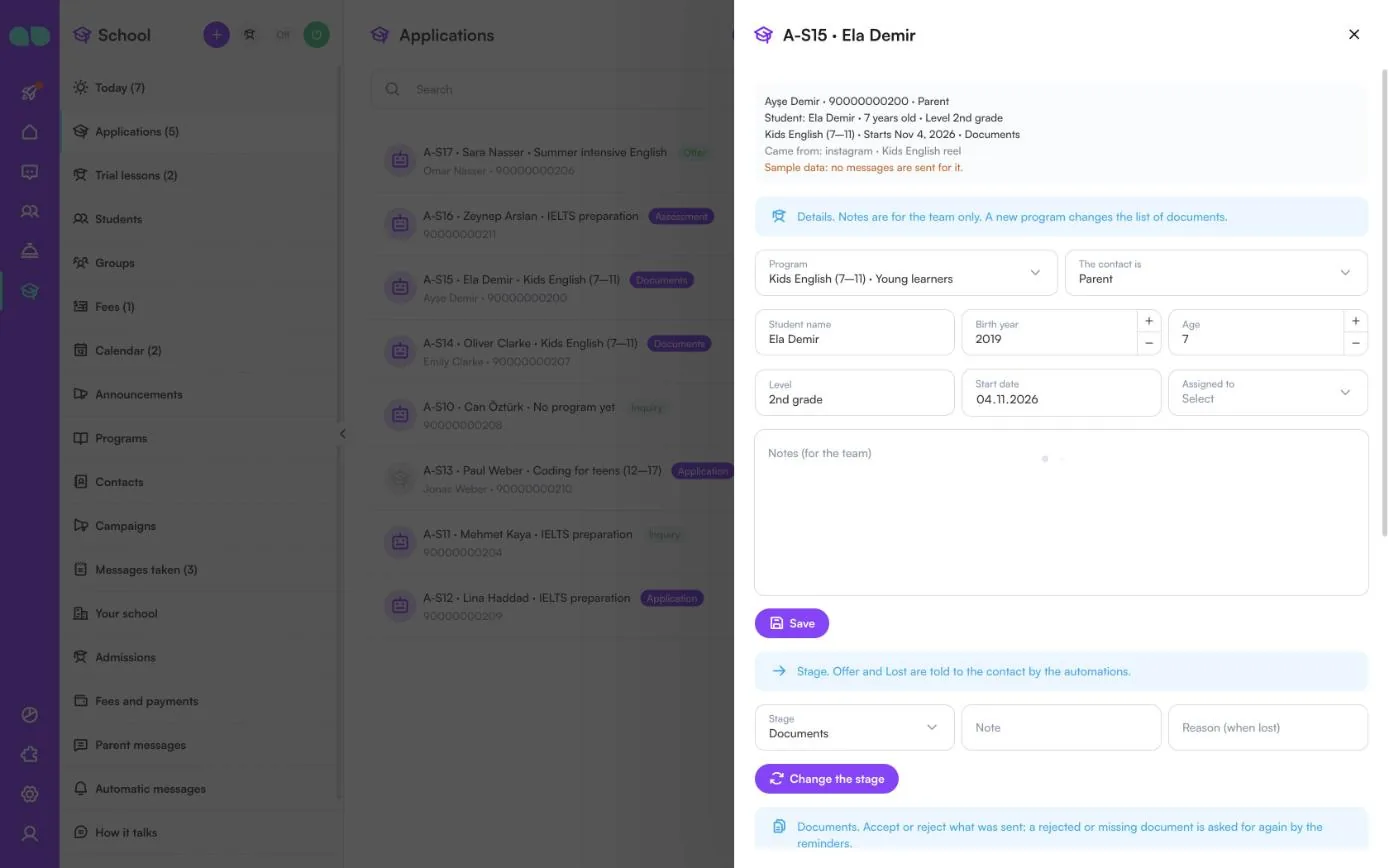
Application drawer
Click an application to open it. The top shows the contact and phone and whether they are the parent, the student, their age and level, the program and start date, the stage, and where the applicant came from.
- Details: Program, The contact is (parent, guardian or the adult student), Student name, Birth year, Age, Level or grade, Start date, Assigned to and Notes (for the team). A new program changes the list of documents. Click Save.
- Stage: pick a new Stage, add a Note and, when lost, a Reason (when lost), then click Change the stage. Offer and Lost are told to the contact by the automatic messages.
- Enrol: once the program is saved, choose the group, start date and number of installments. The student and the enrolment with its installment plan are created; the registration fee is due first and the course fee is split into monthly installments.
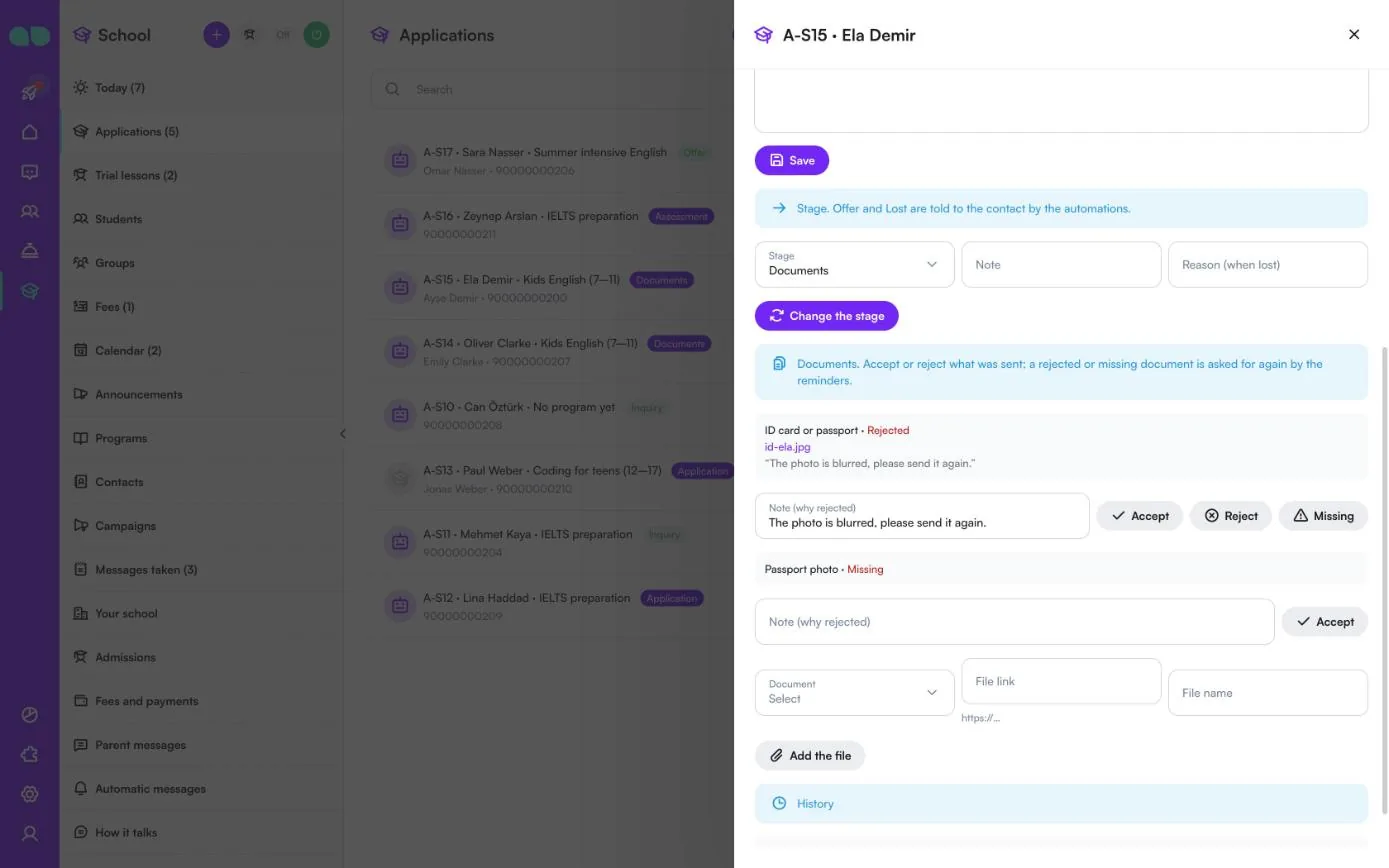
Further down, Documents lists each document the program needs with its state (Received, Accepted, Rejected or Missing) and the file the family sent in the chat. Click Accept or Reject (with a Note (why rejected), so the contact knows what to send), or Missing. A rejected or missing document is asked for again by the reminders. To file a document yourself, choose the Document, paste a File link and File name and click Add the file. When every document is accepted, the application moves to Assessment. History at the bottom lists what happened to the application.
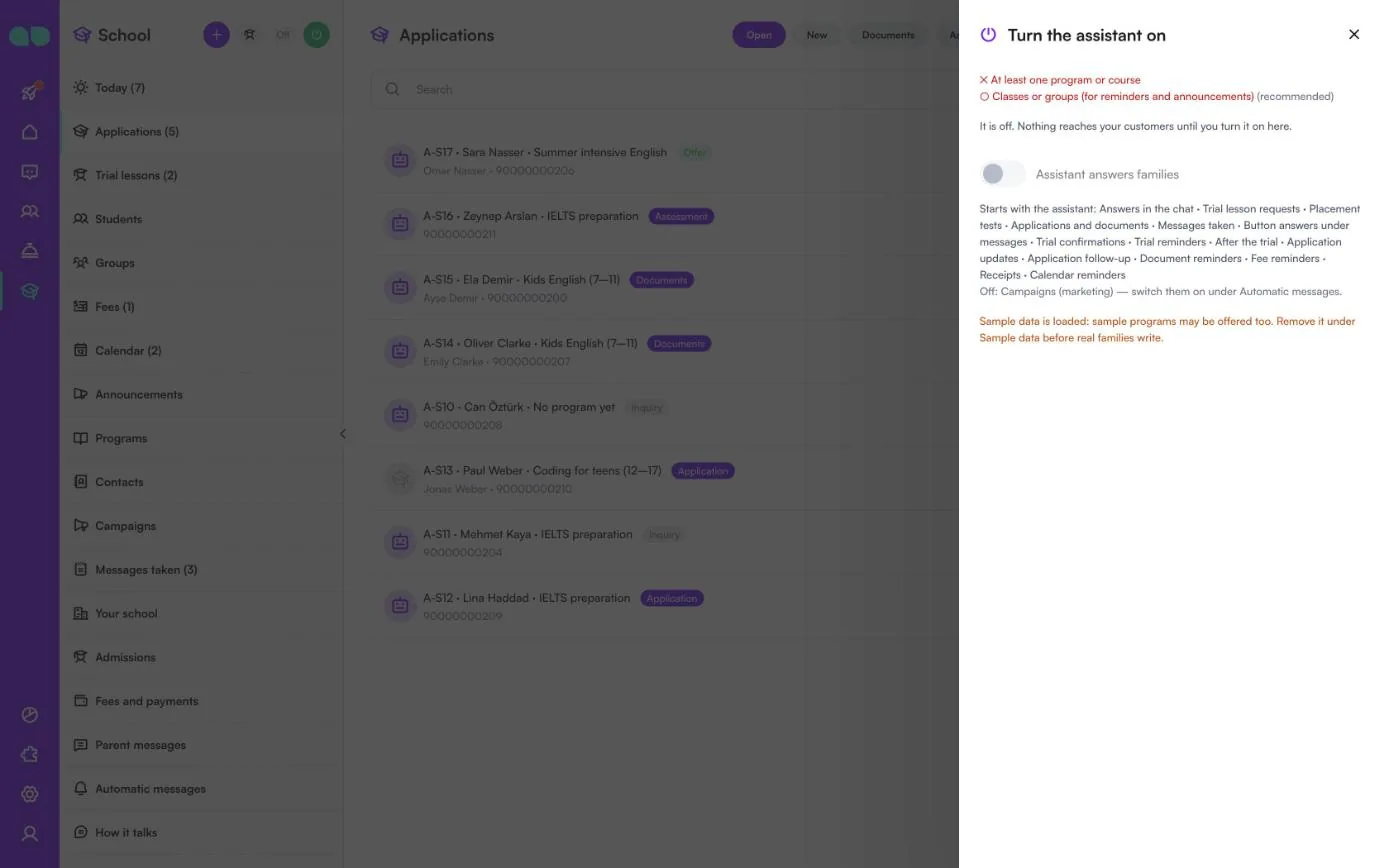
Turn the assistant on
The power button in the header opens this drawer. At the top it lists what is still missing: School name and currency, Office hours, At least one program or course, Hours for trial lessons and placement tests when those are on, and Classes or groups (for reminders and announcements) (recommended).
Switch Assistant answers families on and confirm. Below the switch you see what starts with the assistant (answers in the chat, trial lesson requests, placement tests, applications and documents, messages taken, button answers and each automatic message that is on) and what stays off, such as Campaigns (marketing). A warning reminds you when sample data is still loaded, and another when a different bot is also on in the workspace.
Report
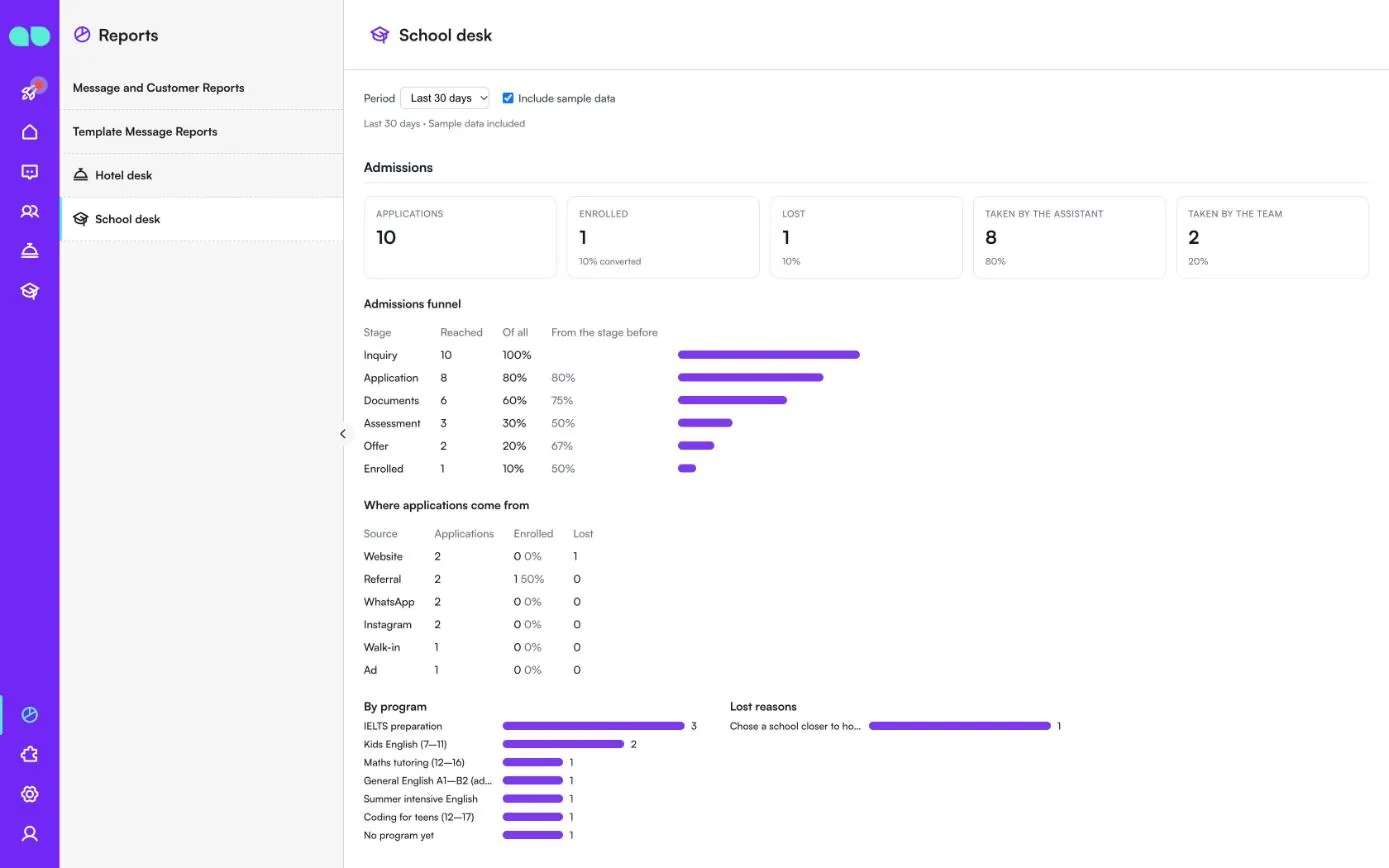
Reports › School desk sums up a Period of 7, 30 or 90 days; tick Include sample data to count the sample records.
- Admissions: Applications, Enrolled, Lost, Taken by the assistant and Taken by the team.
- Admissions funnel: how many applications reached each stage, of all and from the stage before.
- Where applications come from: applications, enrolled and lost per source.
- By program and Lost reasons.
- Further down: trial lessons and their outcomes, documents received, enrolments and fees (invoiced, paid, overdue now, paid by payment link), messages to families and campaigns.
Features
Programs as cards
The right program by age, level, subject and format (in person, online or hybrid), sent as cards with photos, fees and schedule.
Trial lessons and placement tests
It offers the free times and books them. A booking can be a request your office confirms, or confirmed at once while there are places.
Applications
It starts the application, collects the student’s details and asks for the documents your program needs: ID, photo, transcript, birth certificate, health report or your own types.
Enrol in one step
Pick the group, start date and number of installments, and the student, enrolment and payment plan are created.
Payments
With a payment integration, Pay now sends a payment link, the payment is recorded by itself and a receipt goes out. Without one, your payment instructions are sent. Cash, card or bank payments can be recorded at the office.
Groups and calendar
Classes with their program, teacher, schedule and room. Exams, deadlines, holidays, results and events, for one group or all, with a reminder to families a set number of days before.
Announcements and parent messages
A message to one or more groups, sent a little at a time. A parent’s message for a teacher is noted and assigned to the class teacher.
Reports
Over 7, 30 or 90 days: the admissions funnel by source and program and why applicants were lost, trial lessons, enrolments, fees invoiced, paid and overdue, documents, announcements and campaigns.
Screenshots
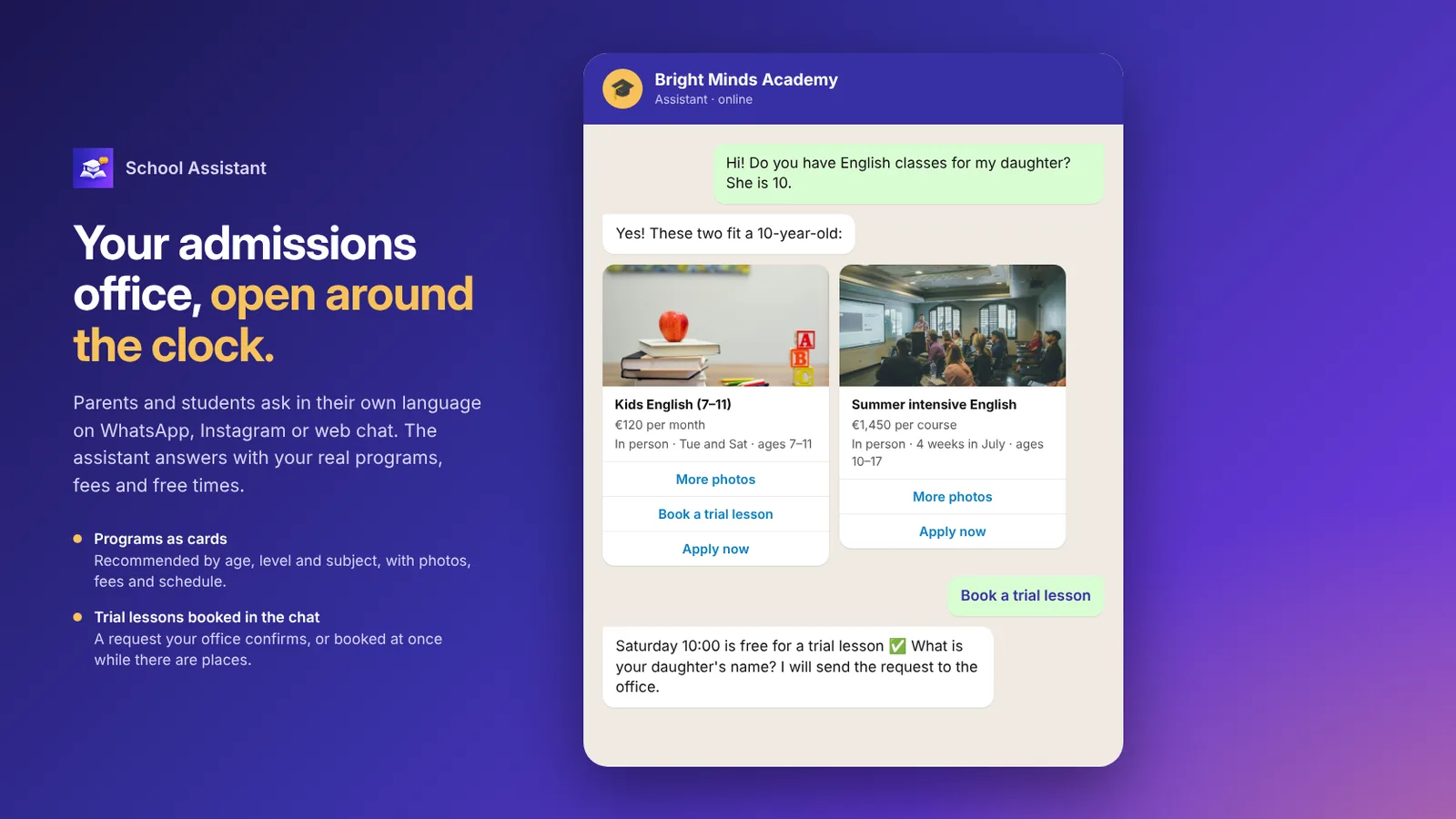 School Assistant sending programs as cards with fees and booking a trial lesson
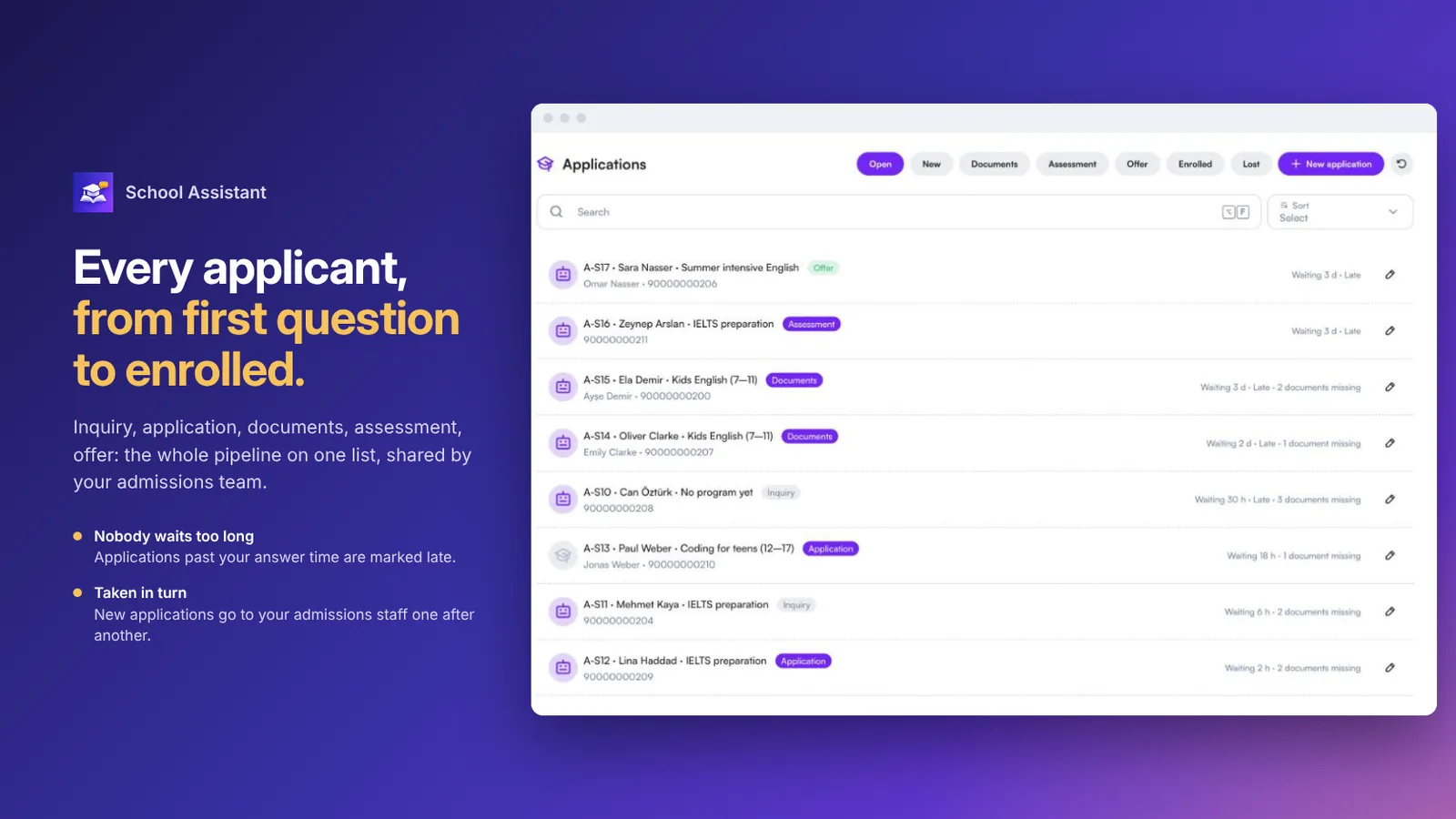 Applications list with every stage from inquiry to enrolled
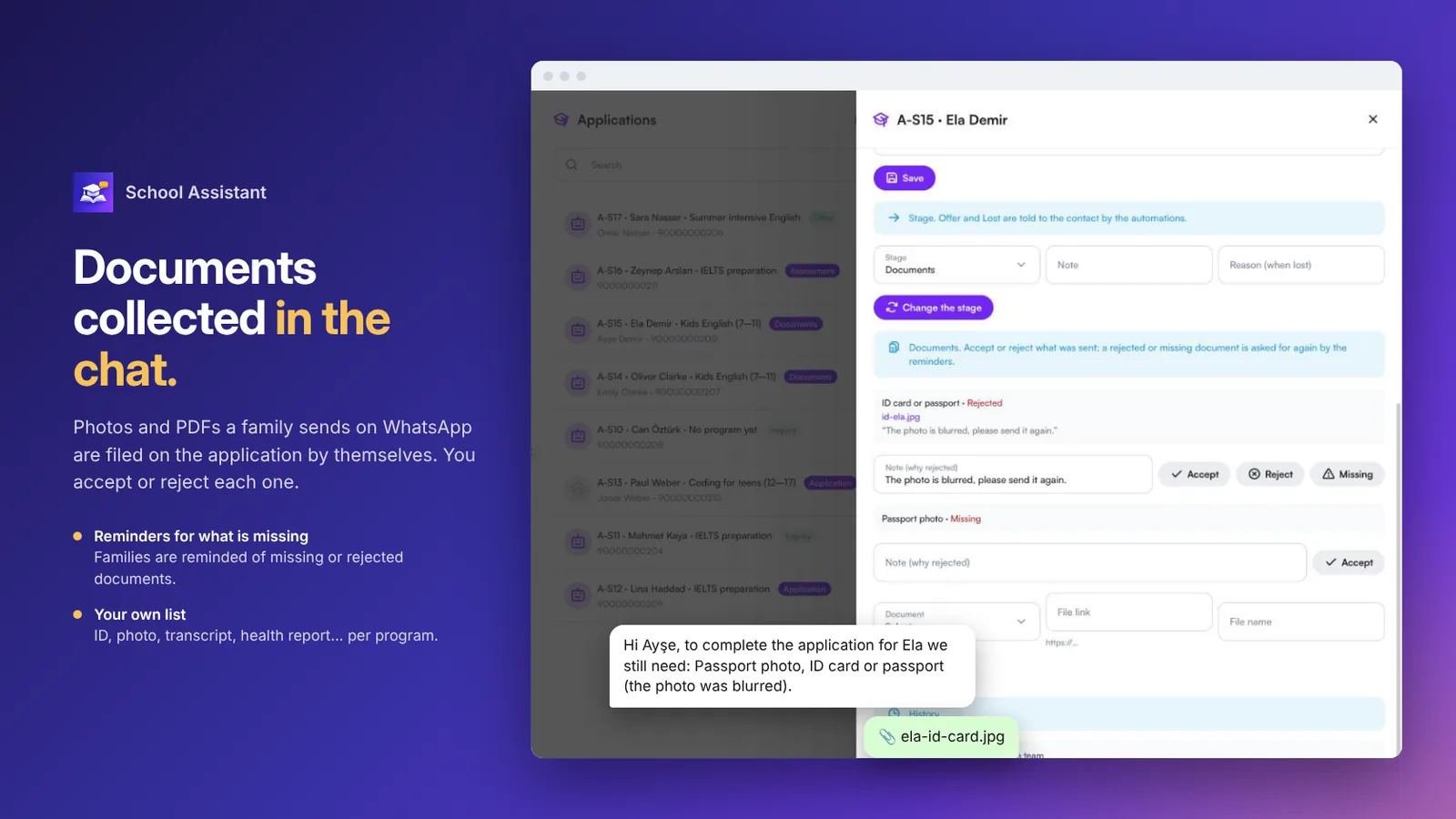 An application with documents accepted, rejected or missing, and a reminder to the family
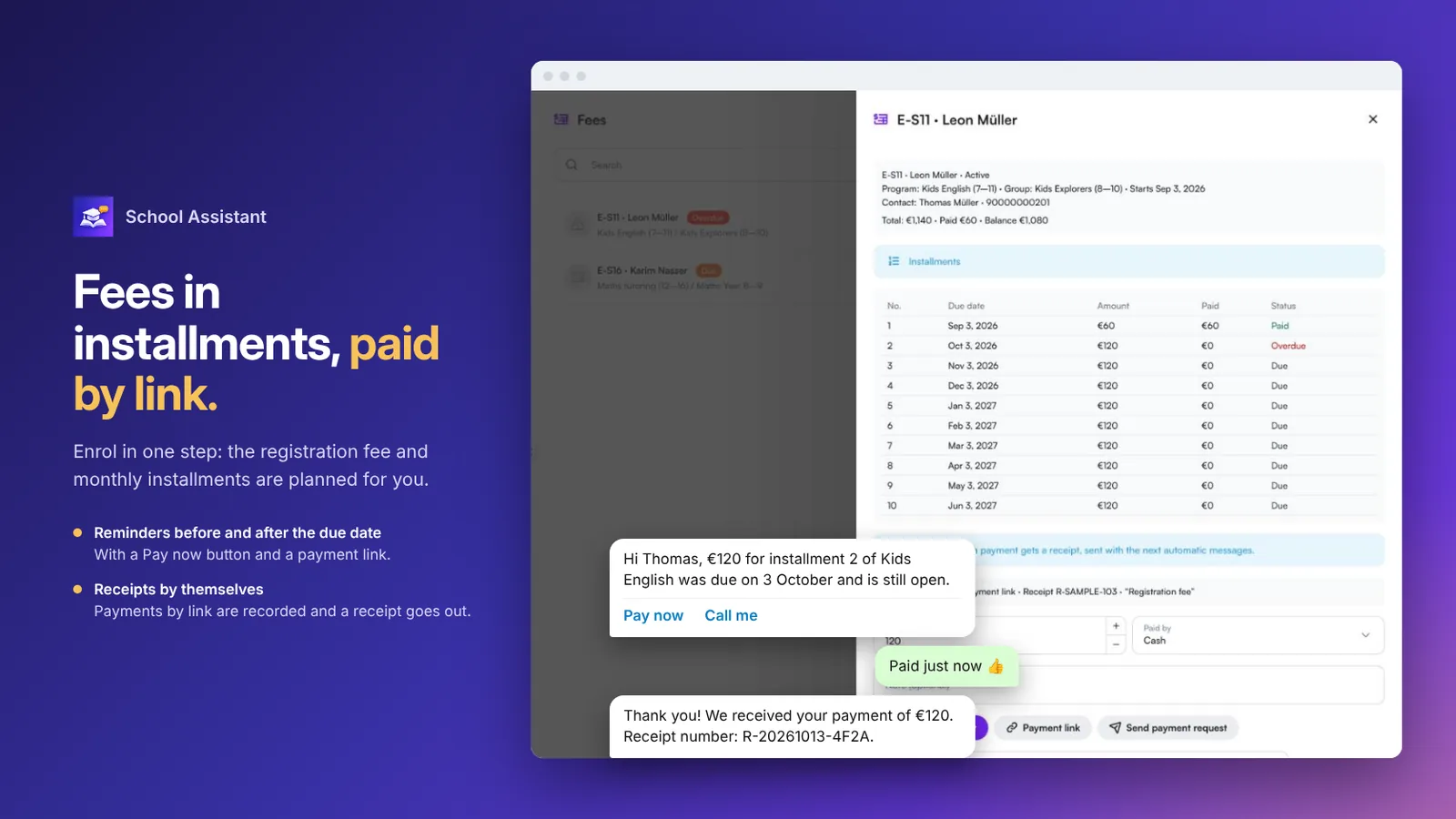 Fee installments with a reminder, Pay now and a receipt
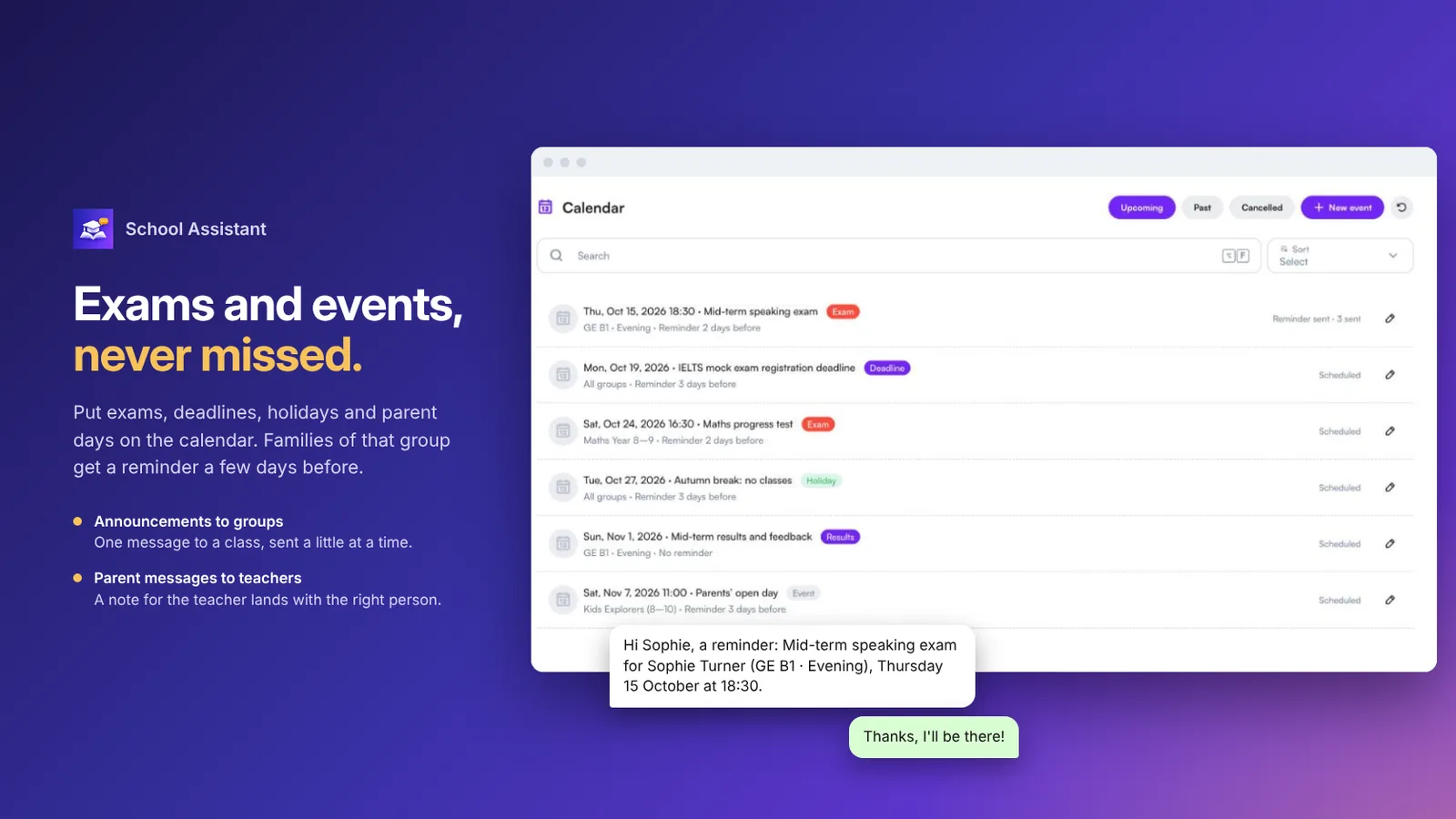 Calendar of exams, deadlines and events with reminders to families
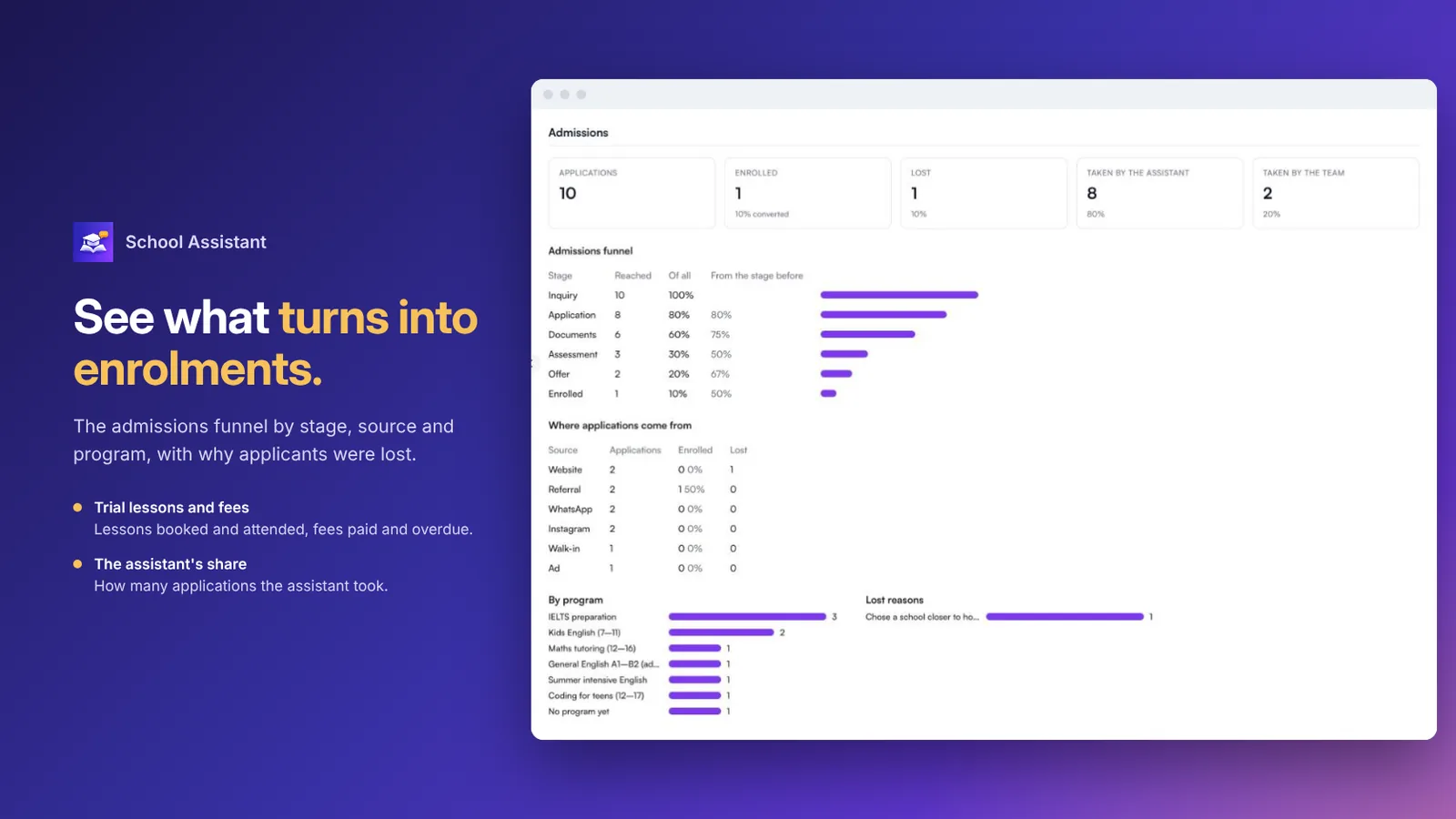 Admissions report with the funnel, sources, programs and lost reasons
FAQ
Which institutions is it for?
Language schools, course and tutoring centres, private schools and university admissions offices. You choose the kind of institution once, and the wording, documents and defaults follow it.
Can it book trial lessons and placement tests?
Yes. It offers the free times and books them. A booking can be a request your office confirms, or confirmed at once while there are places.
How are application documents collected?
Each program lists what it needs. Photos and PDFs sent in the chat are filed on the application by themselves. You accept or reject each one, and the family is reminded of what is still missing.
Can families pay fees in the chat?
Yes. Reminders go out before an installment is due and when it is overdue, with Pay now and Call me. With a payment integration, Pay now sends a payment link and the payment is recorded; without one, your payment instructions are sent.
Does it help with families already enrolled?
Yes. It answers what is due, sends the payment link, reminds families of exams and events, sends announcements to groups and passes a parent’s message to the class teacher.
Which channels and languages does it support?
WhatsApp, Instagram and web chat, around the clock, in the parent’s or student’s own language, including voice messages.