Channels
The Channels feature allows businesses to connect and manage various messaging platforms such as WhatsApp Business API, Facebook Messenger, Instagram, TikTok, Telegram Bot, and WebChat. Businesses can add multiple instances of the same type of channel, enabling them to send and receive messages through these platforms seamlessly.
Accessing Channels
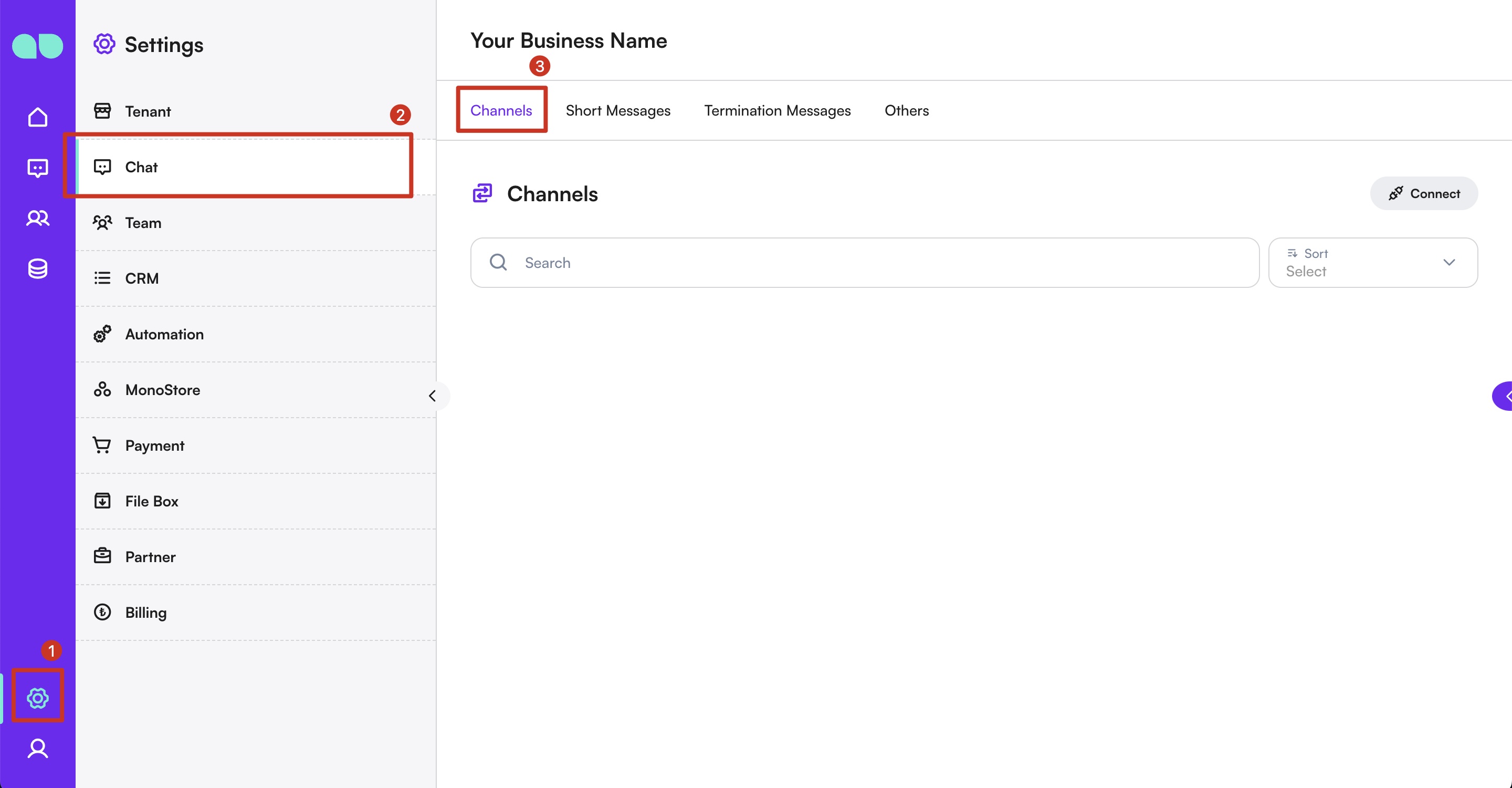
- Navigate to the
Settingssection from the sidebar. - Click on
Chatunder theSettingsmenu. - Select the
Channelstab.
Adding a Channel
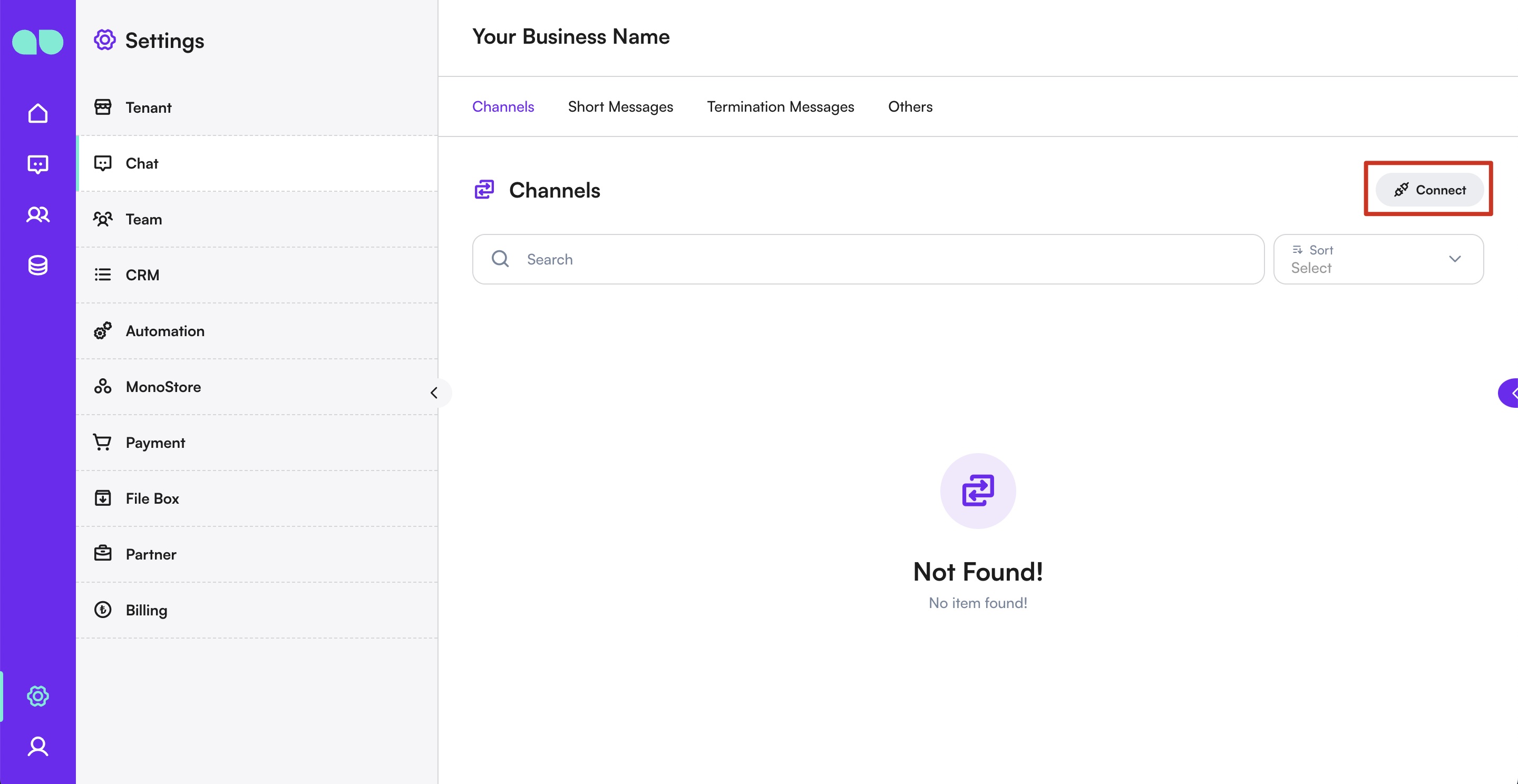
- Click the
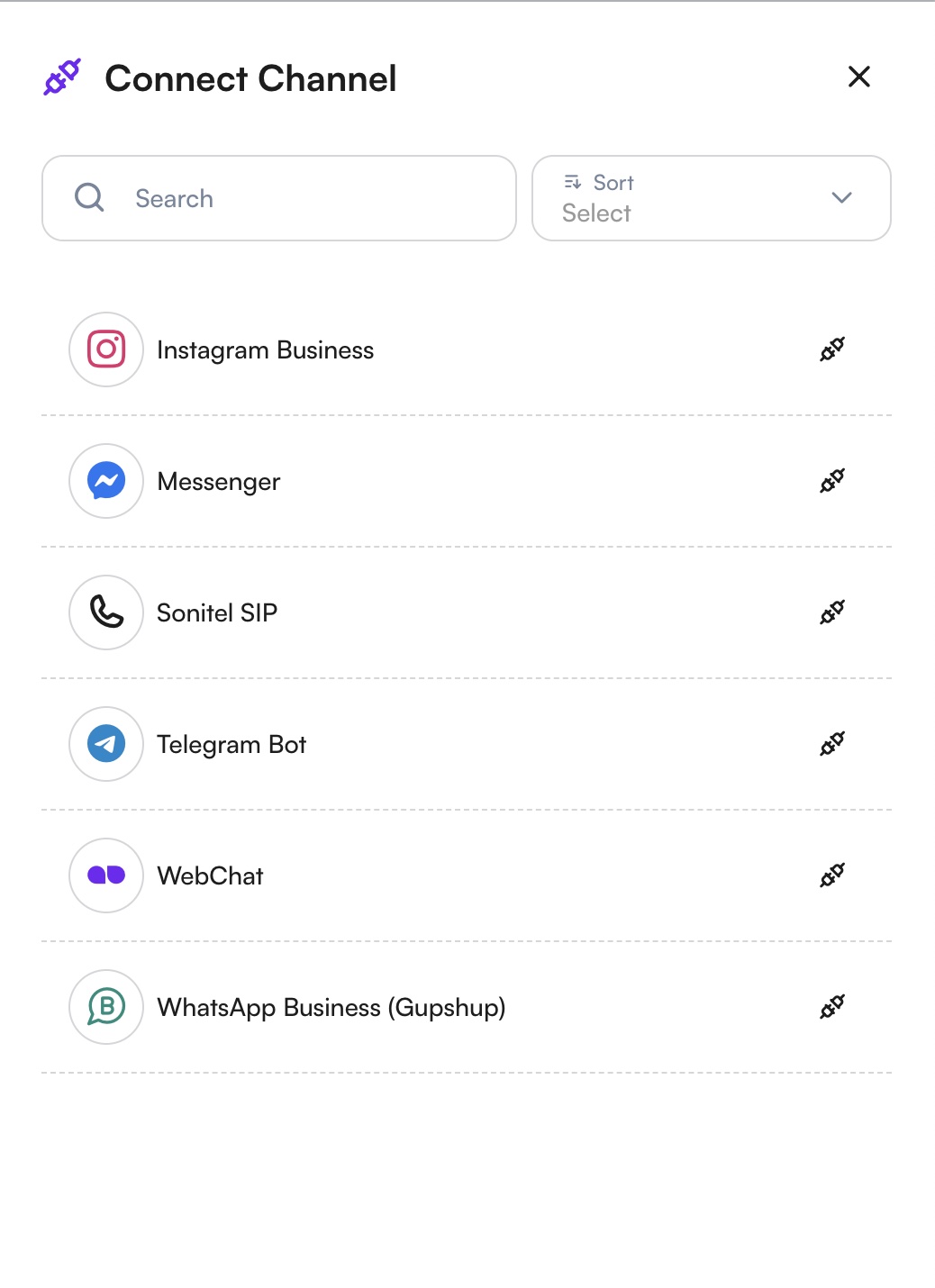
Connectbutton on the right-hand side. - A list of available channel types will appear.
- Select the type of channel you wish to add (e.g., WhatsApp Business API, Facebook Messenger, Instagram, Telegram Bot, WebChat).
- Complete the related steps according to the selected channel type.
WhatsApp Business API
WhatsApp Coexistence Support (New)
MonoChat now supports WhatsApp Coexistence.
With this feature, businesses can use the same WhatsApp phone number on both the WhatsApp Business App and WhatsApp Business API (Cloud) at the same time.
With Coexistence:
- Teams can continue handling manual conversations via the WhatsApp Business App
- Automations, notifications, and integrations run through Cloud API
- There is no need to delete or migrate away from the WhatsApp Business App
Note: WhatsApp Coexistence is available only for eligible accounts and phone numbers supported by Meta.
Sync contacts and message history
When the number you connect is in use on the WhatsApp Business App, MonoChat asks right after connecting whether to bring in what is on the app: WhatsApp Business App Connected Successfully, with Skip and Sync Now.
- Sync Now syncs the contacts first and, 10 seconds later, the message history.
- Skip closes the dialog without syncing anything.
What is synced:
- Contacts: the contacts saved in the WhatsApp Business App are added to CRM as customers, with their name and phone number. A number that is already in CRM is not added again.
- Message history: the past chats that WhatsApp shares from the app, with your customers' messages and the ones you sent from the app. WhatsApp decides how far back the history goes. Chats with customers who have no conversation on this channel yet arrive as history sessions, which MonoChat keeps out of the session list (see History sessions). While the history arrives, the channel's row in Settings › Chat › Channels shows History syncing (N%).
Contacts and history can only be synced within 24 hours of connecting the channel. If you chose Skip, or connected from a mobile device, where the dialog is not shown, open the channel's ⋮ menu in Settings › Chat › Channels and choose Sync History Contact or Sync History Message. After 24 hours both items are disabled.
Create A New WhatsApp Business API (Cloud)
- Select
WhatsApp Business API (Cloud)from the list. - Read the service agreement by scrolling all the way to the bottom of the drawer. Once the confirmation checkboxes appear, mark all required checkboxes.
- Click Continue to proceed.
- Choose the country of your business.
- This selection determines the data storage region, which defines where your message data is stored at rest. Selecting the appropriate region helps ensure local data protection compliance and provides better localization for your WhatsApp message data.
- Click Connect New Number to proceed.
- A Facebook (Meta) login popup will appear.
- Select the Facebook account you want to continue with.
- If you are not logged in, enter your credentials to proceed.
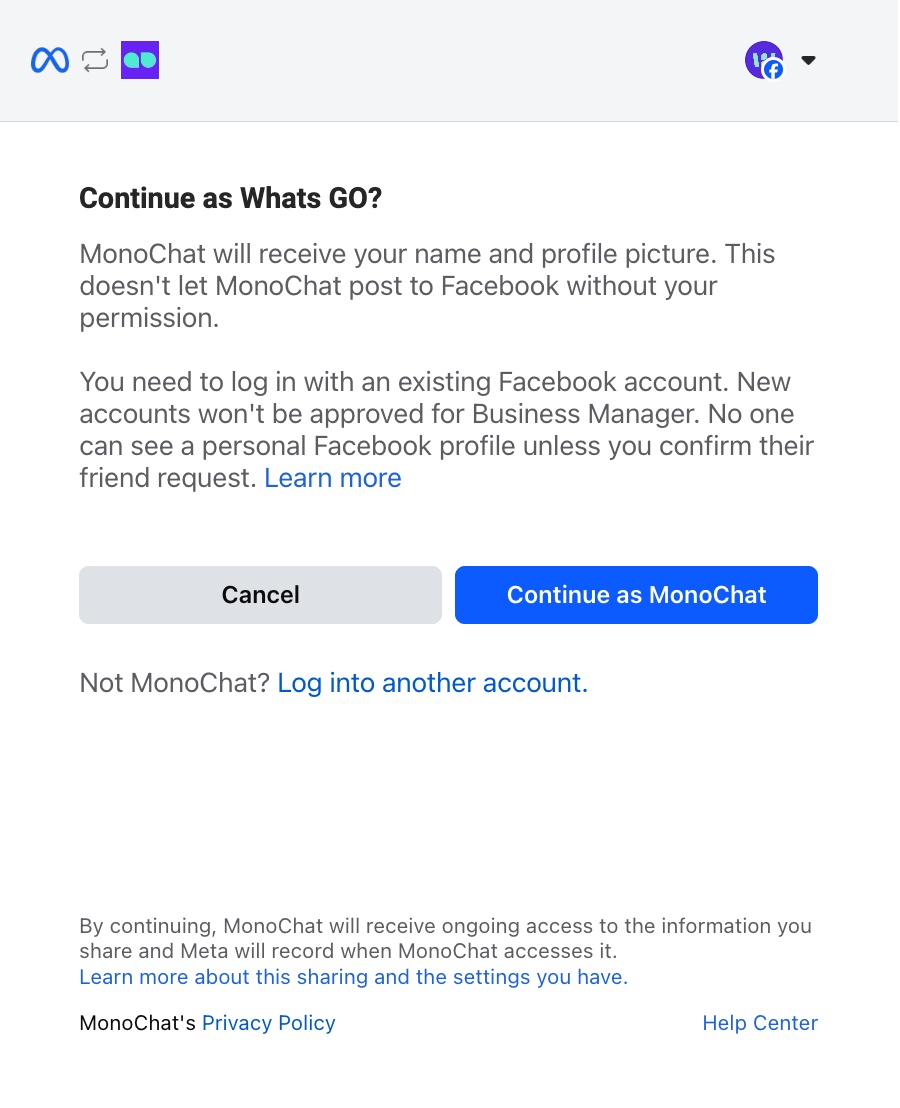
- Click Get Started on the Meta screen.
- This step allows MonoChat to access your WhatsApp Business account.
- Meta will display the permissions MonoChat requires, such as managing phone numbers, creating templates, sending/receiving messages, assigning users, and accessing metrics.
- By continuing, you confirm that you agree to the WhatsApp Business Terms of Service, Meta Terms of Service, and Business Tools Terms of Service.
- Select the Business Account you want to connect the phone number to.
- Choose the appropriate WhatsApp-enabled business from the list of accounts you have access to.
- Click Continue to proceed.
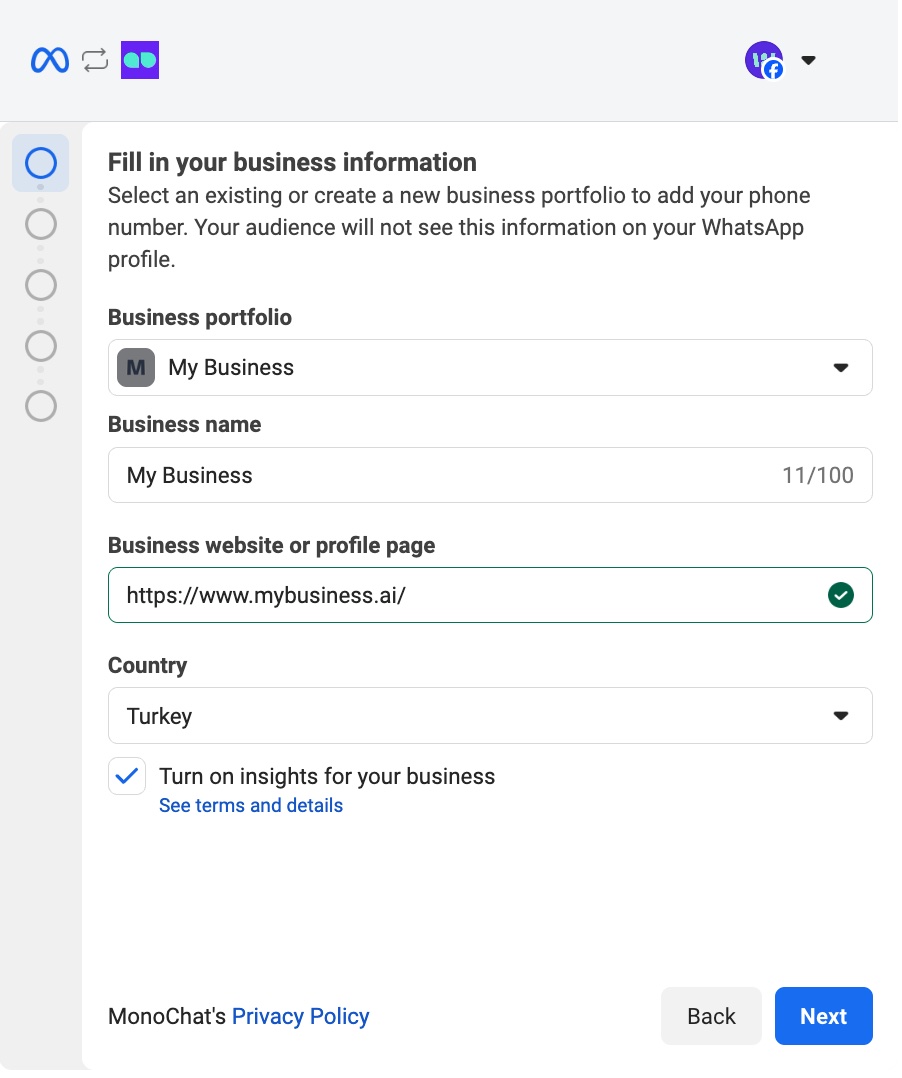
- Create your WhatsApp Business Account and WhatsApp Business Profile.
- Make sure both Create WhatsApp Business Account and Create WhatsApp Business Profile options are selected.
- If you want to use WhatsApp Coexistence:
- Select Connect a WhatsApp Business App at this step.
- This option allows you to connect an existing WhatsApp Business App phone number with Cloud API.
- Follow the on-screen instructions provided by Meta to complete the setup.
Info:
When Coexistence is enabled, your WhatsApp Business App remains active while MonoChat connects the same phone number via Cloud API.
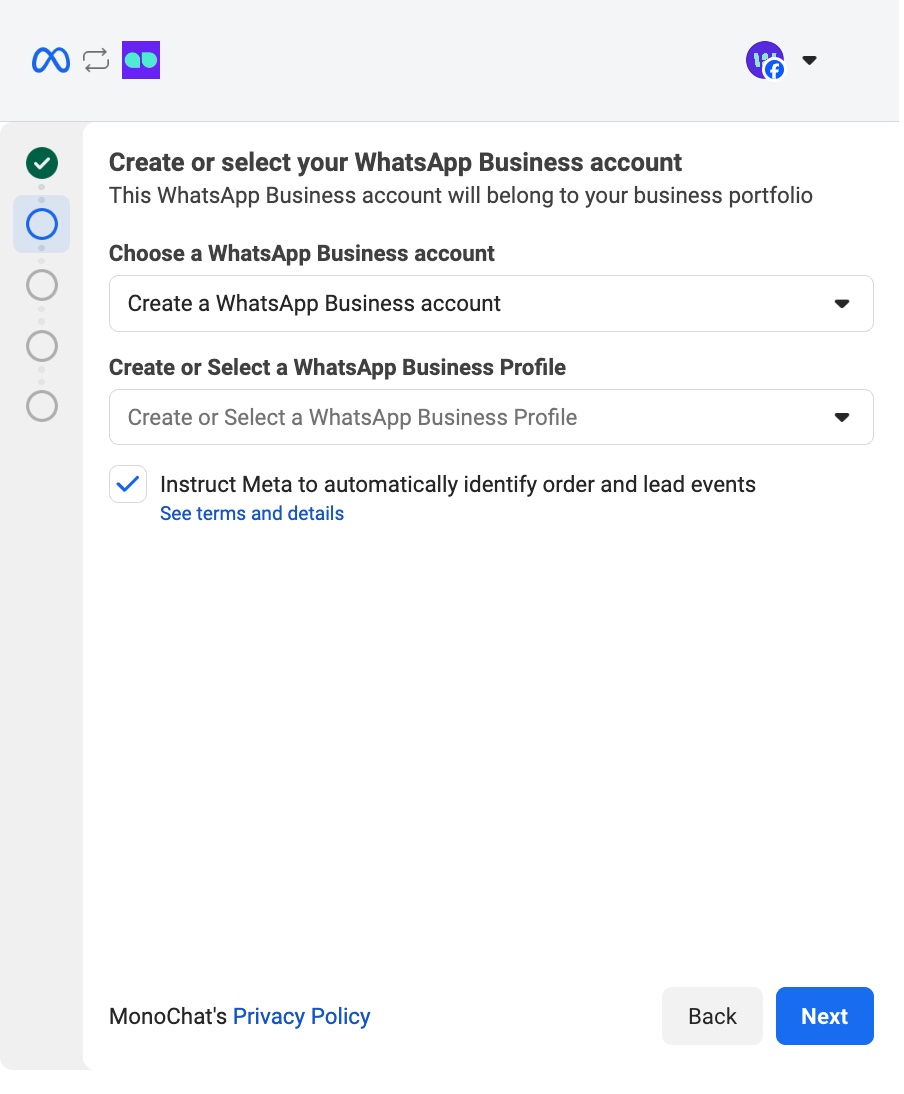
If you already have a WhatsApp Business Account and Profile previously onboarded via Cloud API, you can simply select them and continue instead of creating new ones.
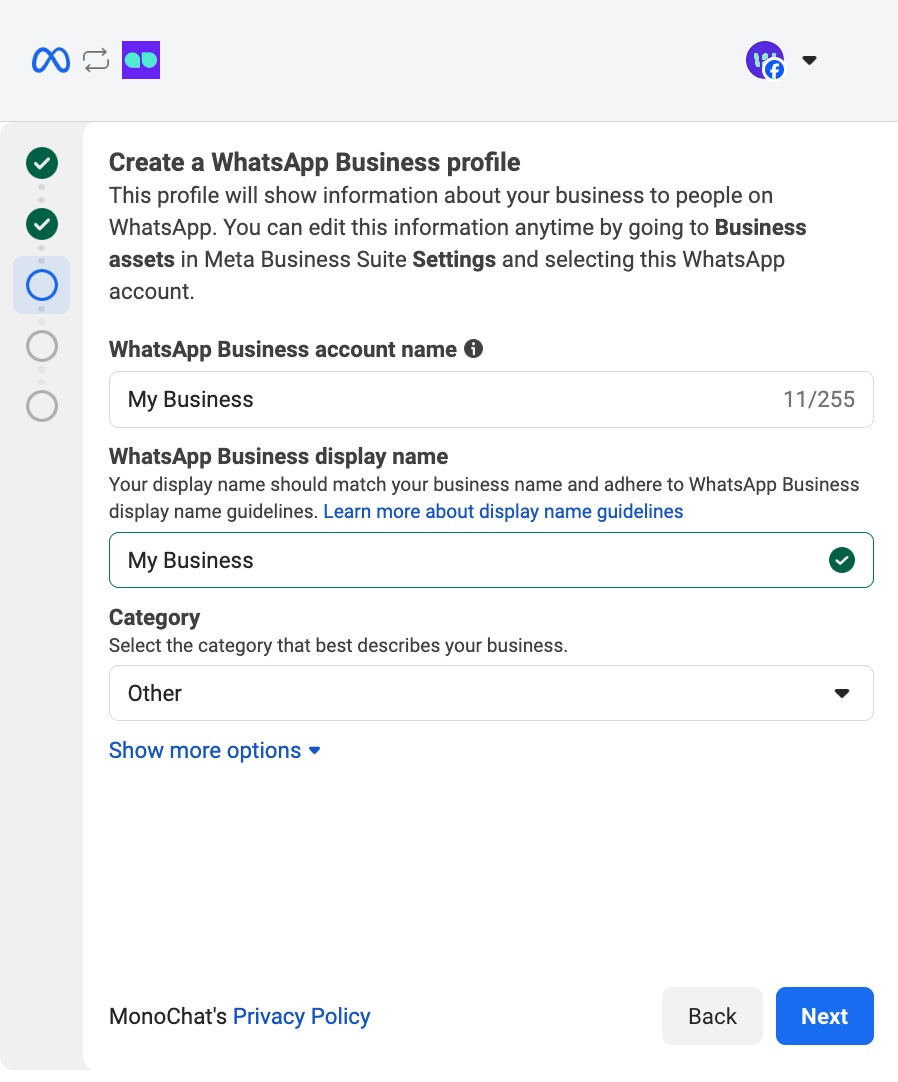
- Create your WhatsApp Business Profile.
- Enter your WhatsApp Business Account Name and Display Name.
- Select the appropriate Business Category for your company.
- This profile information will be visible to users on WhatsApp. You can update it anytime from Meta Business Suite → Business Assets → WhatsApp Accounts.
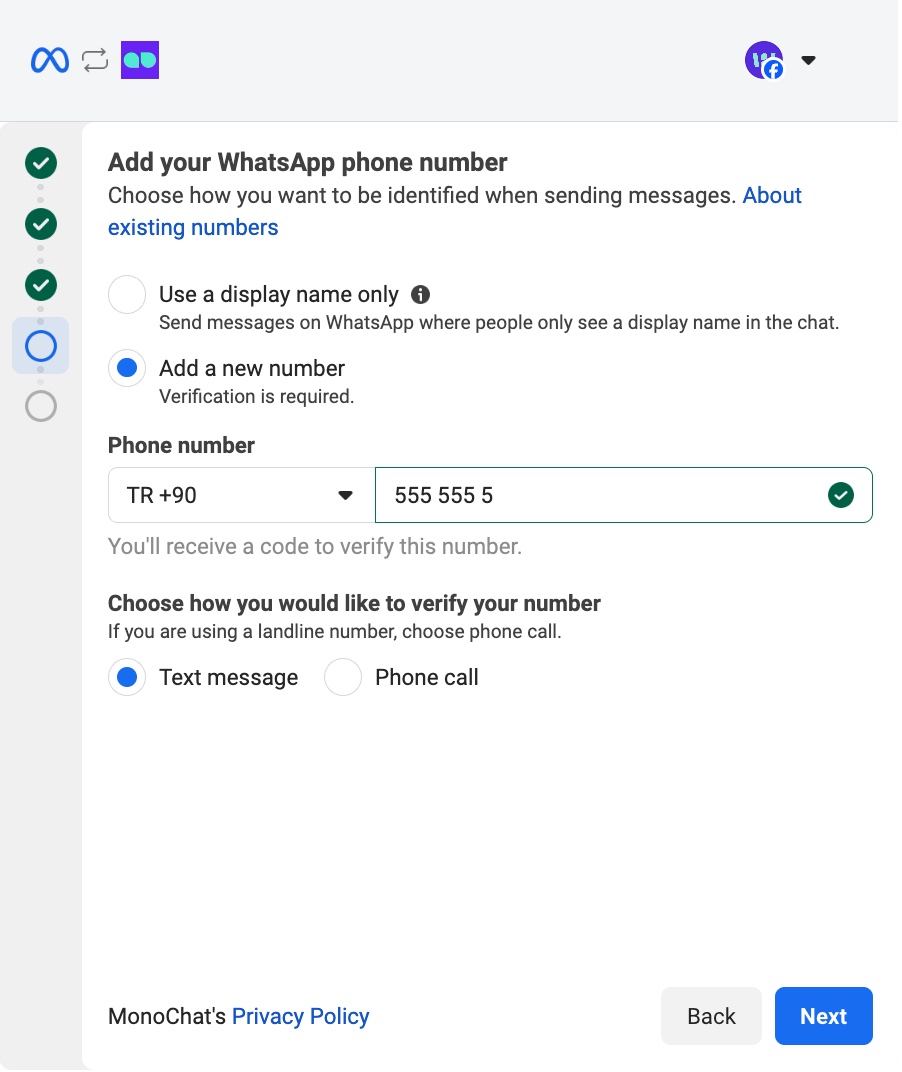
- Add your WhatsApp phone number.
- Click Add New Number and enter the phone number you want to connect.
- Choose your preferred verification method:
- Text Message
- Phone Call (recommended if you are using a landline number)
- A 6-digit verification code will be sent based on the method you select, and you will enter this code in the next step.
The phone number you enter must not be associated with an existing WhatsApp or WhatsApp Business account.
If the number is already in use, the WhatsApp account must be removed before proceeding. A number that is in use on the WhatsApp Business App does not have to be removed: choose Connect a WhatsApp Business App in step 9 to connect it with WhatsApp Coexistence instead.
-
Enter the 6-digit verification code and complete the setup.
- After entering the code, click Finish to finalize the process.
- Once completed, your phone number will be automatically connected to MonoChat.
If you encounter any errors during any of the steps above, you can contact our support team via WhatsApp for assistance:
Create A New WhatsApp Business API (Gupshup)
- Select
WhatsApp Business API (Gupshup)from the list. - Fill in the necessary details: phone number, APP ID, APP Name, and WAB API Key (for Gupshup).
- Click
Saveto add the channel.
Instagram Business
- Select
Instagram Businessfrom the list. - In the drawer, click Connect with Facebook.
- This will open a Meta (Facebook) login popup to continue the connection.
- If the popup does not appear, check your browser's popup blocker and allow popups for the MonoChat domain.
- In the Meta popup, you will see the screen titled “Connect your account to MonoChat.”
- If the currently logged-in Facebook account is correct, simply click Continue to proceed.
- If it is not the correct account, click Switch Account and log in with the appropriate Facebook account before continuing.
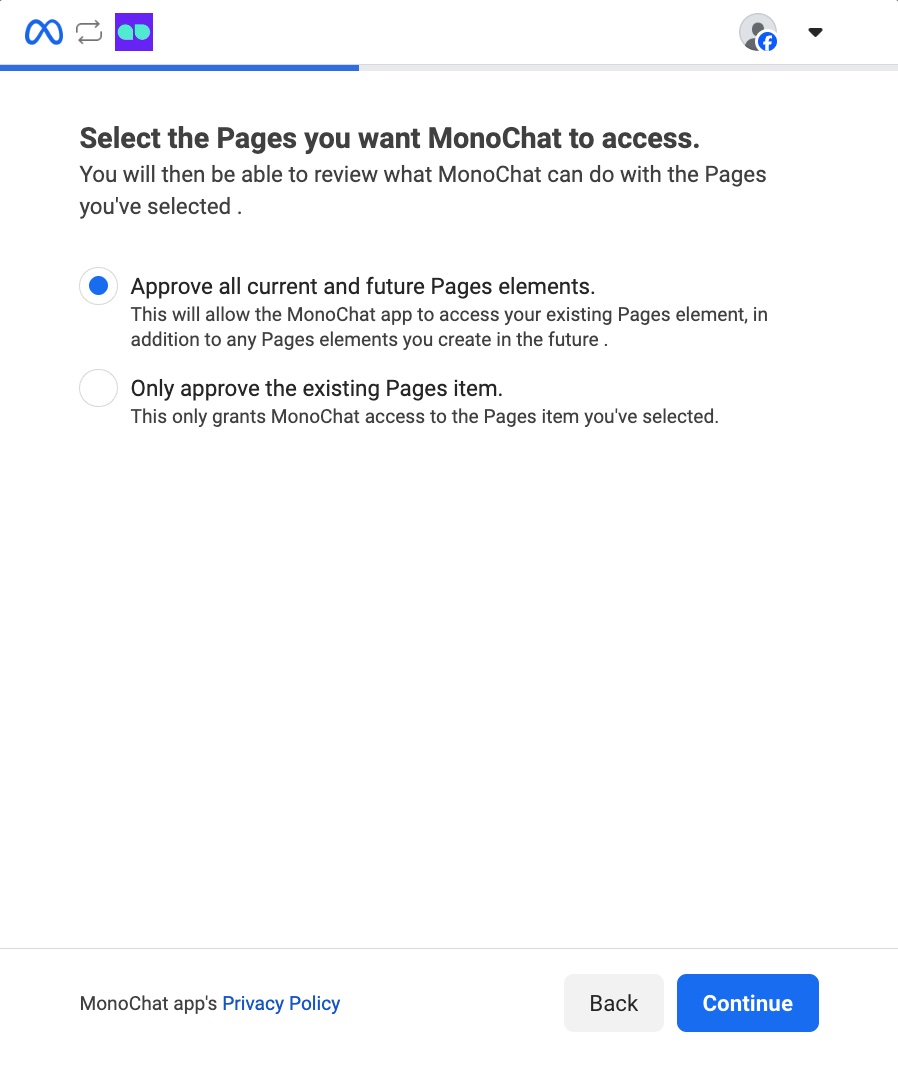
- Select the Facebook Pages you want MonoChat to access.
- Approve all current and future Pages: This grants MonoChat access to your existing Pages as well as any Pages you create in the future.
- Approve only the selected Page: This option limits access to only the specific Page you choose.
After selecting the appropriate option, click Next to continue.
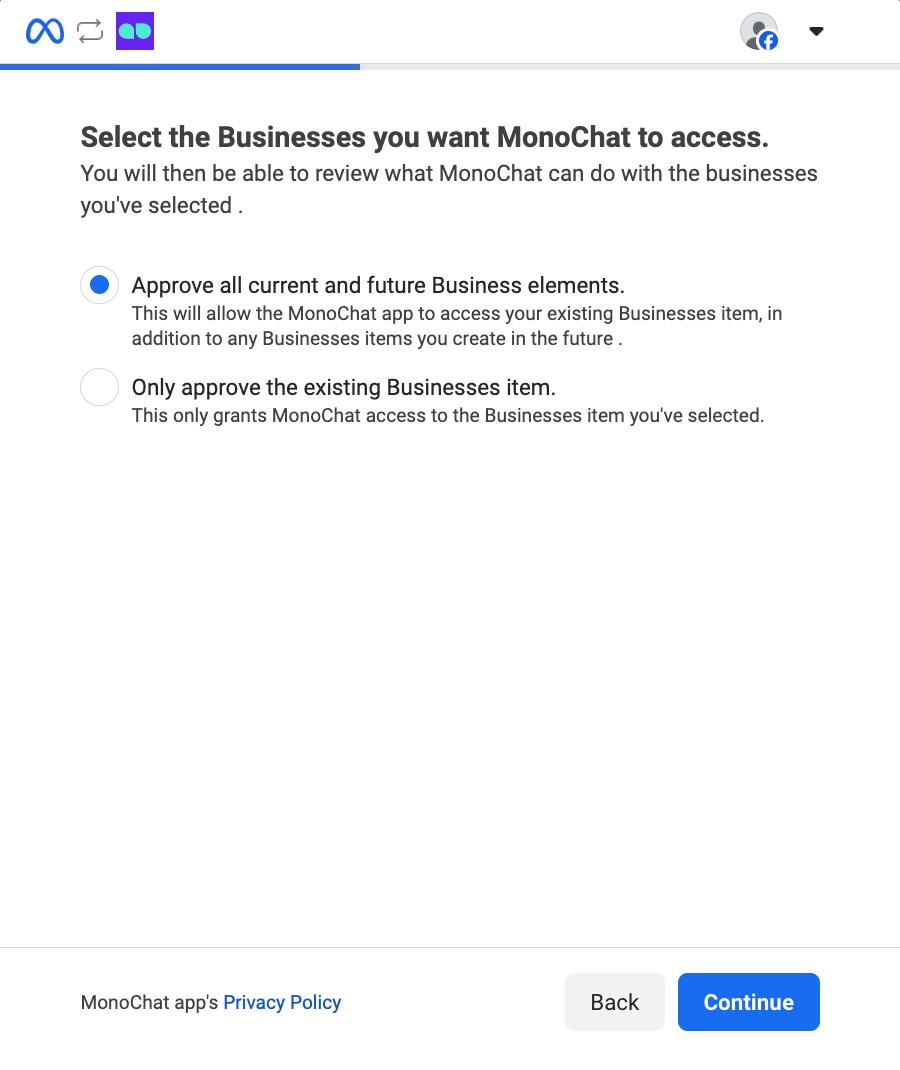
- Select the Businesses you want MonoChat to access.
- Approve all current and future Business elements: Grants MonoChat access to your existing Business assets and any new Business assets you create in the future.
- Approve only the selected Business: Limits MonoChat's access to only the specific Business asset you choose.
Once you’ve made your selection, click Next to proceed.
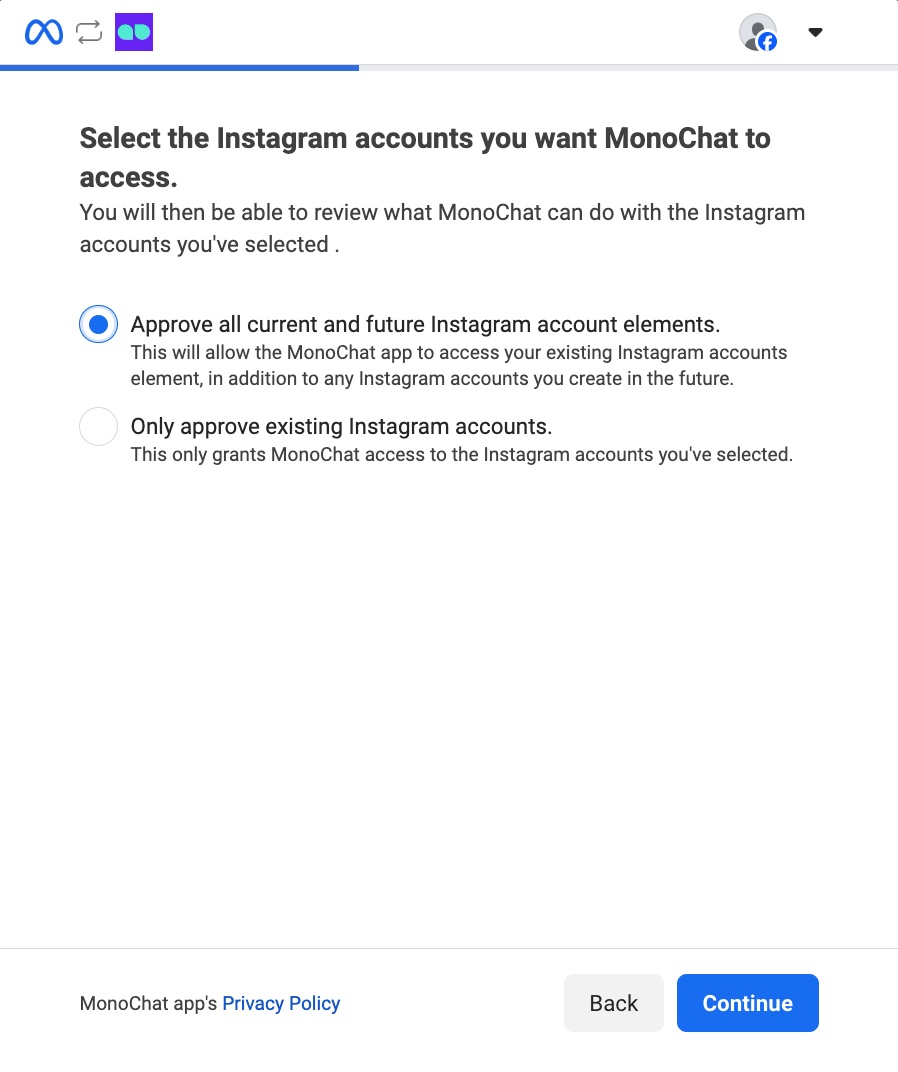
- Select the Instagram Accounts you want MonoChat to access.
- Approve all current and future Instagram Accounts: Grants MonoChat access to your existing Business assets and any new Business assets you create in the future.
- Approve only the selected Instagram Accounts: Limits MonoChat's access to only the specific Business asset you choose.
Once you’ve made your selection, click Next to proceed.
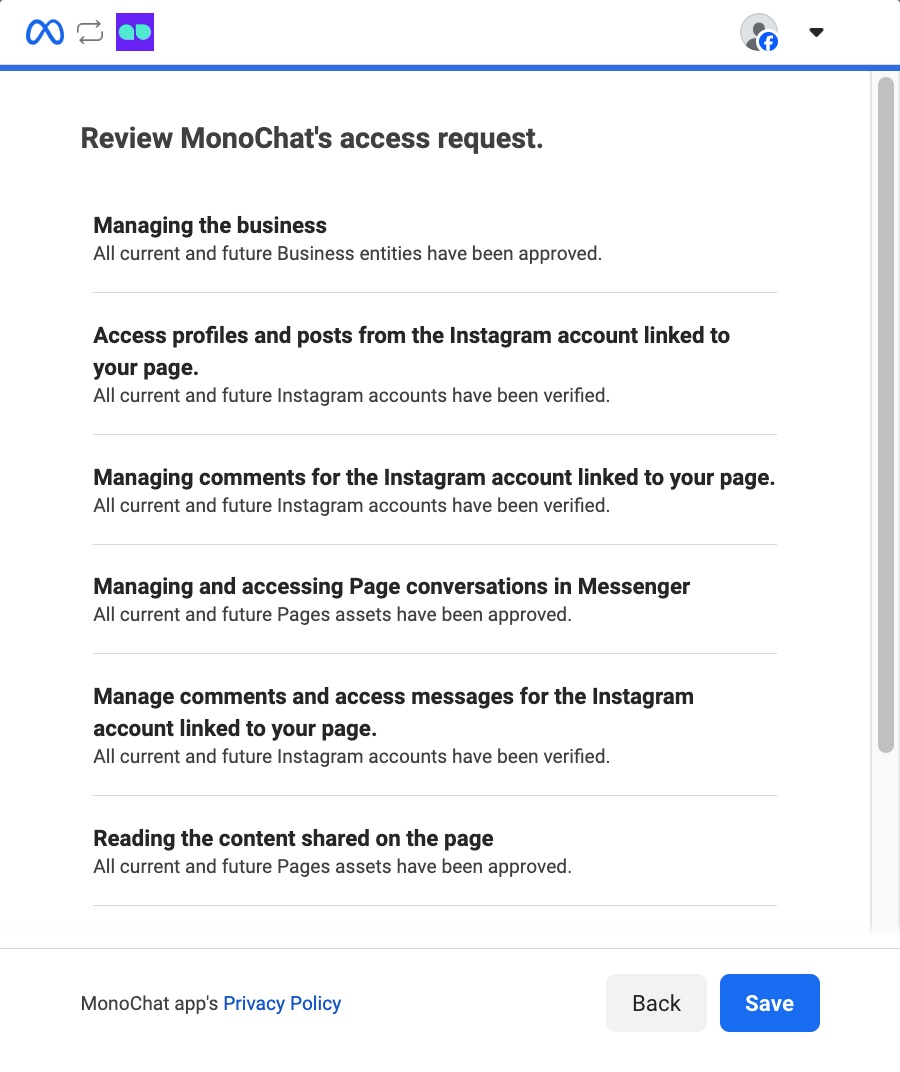
- Review MonoChat’s access permissions and click Save to continue.
-
After saving, the Meta pop-up will close automatically.
MonoChat will then display all available Instagram accounts on the right side.
Simply click Connect next to the account you want to link.If more than 30 minutes pass before you choose an account, the Facebook login expires and MonoChat asks you to connect again.
Facebook Messenger
- Select
Facebook Messengerfrom the list. - In the drawer, click Connect with Facebook.
- This will open a Meta (Facebook) login popup to continue the connection.
- If the popup does not appear, check your browser's popup blocker and allow popups for the MonoChat domain.
- In the Meta popup, you will see the screen titled “Connect your account to MonoChat.”
- If the currently logged-in Facebook account is correct, simply click Continue to proceed.
- If it is not the correct account, click Switch Account and log in with the appropriate Facebook account before continuing.
- Select the Facebook Pages you want MonoChat to access.
- Approve all current and future Pages: This grants MonoChat access to your existing Pages as well as any Pages you create in the future.
- Approve only the selected Page: This option limits access to only the specific Page you choose.
After selecting the appropriate option, click Next to continue.
- Select the Businesses you want MonoChat to access.
- Approve all current and future Business elements: Grants MonoChat access to your existing Business assets and any new Business assets you create in the future.
- Approve only the selected Business: Limits MonoChat's access to only the specific Business asset you choose.
Once you’ve made your selection, click Next to proceed.
- Select the Instagram Accounts you want MonoChat to access.
- Approve all current and future Instagram Accounts: Grants MonoChat access to your existing Business assets and any new Business assets you create in the future.
- Approve only the selected Instagram Accounts: Limits MonoChat's access to only the specific Business asset you choose.
Once you’ve made your selection, click Next to proceed.
- Review MonoChat’s access permissions and click Save to continue.
-
After saving, the Meta pop-up will close automatically.
MonoChat will then display all available Facebook Messenger accounts on the right side.
Simply click Connect next to the account you want to link.If more than 30 minutes pass before you choose an account, the Facebook login expires and MonoChat asks you to connect again.
TikTok Business
- Select
TikTok Businessfrom the list. - In the drawer, click Connect TikTok Business.
- This will open a TikTok login popup to continue the connection.
- If the popup does not appear, check your browser's popup blocker and allow popups for the MonoChat domain.
- In the TikTok popup, you will see the screen titled “Log in to TikTok”
- If the currently logged-in TikTok account is correct, simply click Continue to proceed.
- If it is not the correct account, log in with the appropriate TikTok account, using your prefered method, before continuing.
- Sign in with the TikTok Business Accounts you want MonoChat to access.
- Review MonoChat’s access permissions and click Continue.
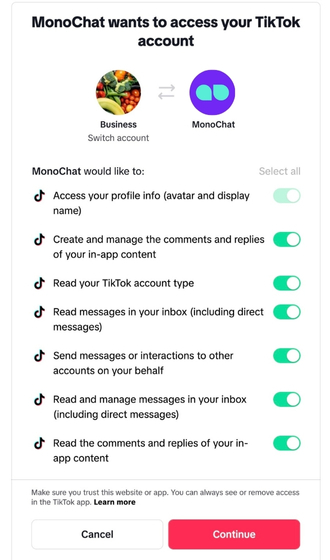
- After approving permissions, your channel will be connected and the TikTok popup will close automatically.
TikTok direct messages support text, images and buttons. You can also answer comments on your TikTok videos, from the chat screen or with the Send Comment flow node (see Message Types).
TikTok messaging limits
TikTok limits how many messages a business can send in a conversation with someone who does not follow it mutually. MonoChat applies these limits in the chat screen, in flows and in bulk messages:
| Situation | What TikTok allows |
|---|---|
| The customer has written and has not replied to your messages yet | Up to 10 messages in the 48 hours after the customer's last message |
| The customer has replied to your messages | Unlimited messages for 48 hours after each reply |
| More than 48 hours have passed since the customer's last message | Up to 3 more messages, until the customer writes again |
- Above the message box, the chat screen shows how many messages are left and until when. When none are left, the message box gives way to a notice; you can send again once the customer writes.
- A flow's Send Message node takes its failed output, and a bulk message marks the recipient as failed with the same reason. Nothing is sent to TikTok.
- If TikTok still rejects a message under these rules, the message shows as failed with the reason "The channel's messaging limit is reached: you can send again when the customer writes."
MonoChat cannot see whether your business follows the customer back, so it applies these limits to every TikTok conversation. In conversations that started before this feature, counting begins with the customer's next message.
Telegram Bot
- Select
Telegram Botfrom the list. - Enter the
Telegram Bot Key. - Click
Saveto add the channel.
WebChat
- Select
WebChatfrom the list. - Fill in the necessary details: Name, Site URL, Welcome Message, etc.
- Click
Saveto add the channel.
Messages API
The Messages API channel connects a messaging service MonoChat does not support out of the box (your own app, an in-house chat, another provider) through a simple HTTP contract. Your service pushes customer messages to MonoChat, and MonoChat posts agent, flow and AI replies back to your service.
-
Select Messages API from the list.
-
Fill in the form:
Field Required What it is Title Yes The channel name shown in MonoChat. Webhook URL No Your endpoint. MonoChat sends outgoing messages and typing events here. Without it, nothing is delivered to your service. Username Yes Basic Auth user name. Used in both directions. Password Yes Basic Auth password. Used in both directions. -
Click Save. MonoChat creates the channel with a random channel ID and marks it connected.
-
Open the channel's ⋮ menu and choose Documentation. The drawer shows ready-to-copy
curlexamples with your real endpoint, channel ID and Basic Auth header.
You can change the title, webhook URL, username and password later with the edit icon on the channel row. The Messages API channel has no 24-hour window and can start conversations, and it is billed like any other channel.
Sending customer messages to MonoChat
Post every customer message to https://app.monochat.ai/api/channels/messages-api/webhooks (the Documentation drawer shows the exact address for your installation) with the header Authorization: Basic base64(username:password).
curl --location --request POST 'https://app.monochat.ai/api/channels/messages-api/webhooks' \
  --header 'Content-Type: application/json' \
  --header 'Authorization: Basic <base64 of username:password>' \
  --data '{
    "meta": { "channel_id": "<your channel ID>", "topic": "MESSAGE_INCOMING" },
    "payload": {
      "type": "text",
      "text": { "body": "Message from customer" },
      "from": { "id": "customer-identifier", "profile": { "name": "Customer Name", "picture": "https://example.com/avatar.jpg" } },
      "to": { "id": "<your channel ID>" },
      "timestamp": 1760000000000
    }
  }'
| Field | Notes |
|---|---|
meta.channel_id | The channel ID shown in the Documentation drawer. |
meta.topic | MESSAGE_INCOMING for a message from the customer. MESSAGE_OUTGOING records a message your own system already sent to the customer (swap from and to), so the conversation in MonoChat stays complete. |
payload.from.id / payload.to.id | The customer's identifier in your system and the channel ID. The customer identifier becomes the customer's channel username in MonoChat. |
payload.from.profile.name, .picture | Optional. Split into first and last name for the CRM profile. |
payload.source_id | Optional. Your own message ID. |
payload.context.source_id or payload.context.omni_message_id | Optional. Marks the message as a reply to an earlier message. |
payload.context.referral | Optional ad or referral data (source_id, source_type, source_url, headline, body, image, video). |
payload.timestamp | Optional, milliseconds. Defaults to the time of receipt. |
Supported payload.type values: text (text.body), image, video, document, audio, voice, sticker (each with url, mime_type and, where it applies, caption), location (latitude, longitude), contacts, button (id, title), list (id, title, description), order, attachments (an array of media items) and flow (response_json). Any other type is stored as an unsupported message.
MonoChat answers 204 when the message is queued, 401 when the channel ID or the Basic Auth credentials do not match, and 422 when meta.channel_id or meta.topic is missing.
Receiving replies from MonoChat
When an agent, a flow or an AI agent sends a message in a Messages API conversation, MonoChat posts it to your Webhook URL with the same Basic Auth credentials (5-second timeout):
{
  "topic": "message",
  "type": "text",
  "text": { "text": "Outgoing message" },
  "senderClientId": "<your channel ID>",
  "customerChannelUsername": "customer-identifier",
  "sessionId": "session-id",
  "messageId": "message-id",
  "createdAt": "2026-10-12T09:00:00.000Z",
  "direction": "outgoing"
}
The type-specific object (text, image, carousel, button, …) follows MonoChat's message format. While an agent types, MonoChat also posts { "topic": "typing", "senderClientId", "customerChannelUsername", "sessionId" }.
Reading sessions and messages
Two endpoints let your service read data back. Both take Basic Auth and a JSON body with slug (your workspace slug) and channelUsername (the channel ID):
POST …/messages-api/sessionsreturns sessions with pagination (options.pagination.currentPage,pageItems) and sorting (options.sorting).POST …/messages-api/messagesalso needscustomerChannelUsernameand returns that customer's messages with pagination. It answers404when there is no session for the customer.
SMS
Selecting SMS opens a second list with the SMS providers MonoChat supports. Pick one and click Connect.
Twilio SMS
Connect a phone number you own in Twilio to send and receive SMS in MonoChat.
| Field | What to enter |
|---|---|
| Phone Number | The Twilio number in international format. |
| Phone Number SID | The SID of that number (starts with PN), from Twilio Console › Phone Numbers. |
| Account SID | Your Twilio account SID (starts with AC). |
| Auth Token | The auth token of the same Twilio account. |
Click Save. Twilio SMS channels can send text, images, video, audio and documents.
Twilio SMS with a Sender ID or a Messaging Service
Instead of a phone number, the Twilio SMS form can connect an alphanumeric Sender ID or a Twilio Messaging Service. Choose it in Sender type.
| Sender type | What to enter | Replies |
|---|---|---|
| Alphanumeric Sender ID | The Sender ID (1–11 letters and digits, at least one letter), plus Account SID and Auth Token. | Not possible: customers cannot reply to a Sender ID. |
| Messaging Service | The Messaging Service SID (starts with MG), plus Account SID and Auth Token. | Only if you also enter the Phone Number SID of a number in that Messaging Service. |
Customers cannot reply to messages sent from this sender. To receive replies, use a Messaging Service with a phone number or a phone number.
Türkiye and the UAE: carriers there deliver SMS only from a Sender ID registered with Twilio; Türkiye blocks unregistered Sender IDs from 18 November 2026, and does not support numeric Sender IDs or local long codes. Register the Sender ID in the Twilio Console (Trust Hub › Alphanumeric Sender ID registration) before you connect it in MonoChat; Twilio says registration takes about two weeks. A short code is connected as a Messaging Service that contains it.
Varan OTP
Varan OTP is an SMS provider for one-time passwords and notifications. Enter the Username and API Key you received from Varan and click Save.
Voice Channel
- Select
Voice Channelfrom the list. - Fill in the necessary details such as SIP account or provider credentials.
- Click
Saveto add the channel.
Getting Contacts to Message You
Most messaging apps require contacts to initiate the conversation before you can engage with them. To encourage new contacts to reach out, MonoChat offers QR codes and chat links as effective solutions. QR codes are perfect for use on posters, flyers, receipts, packaging, and business cards. Meanwhile, chat links make it easy for people to message you directly from social media posts, emails, and websites, seamlessly connecting you with your audience.
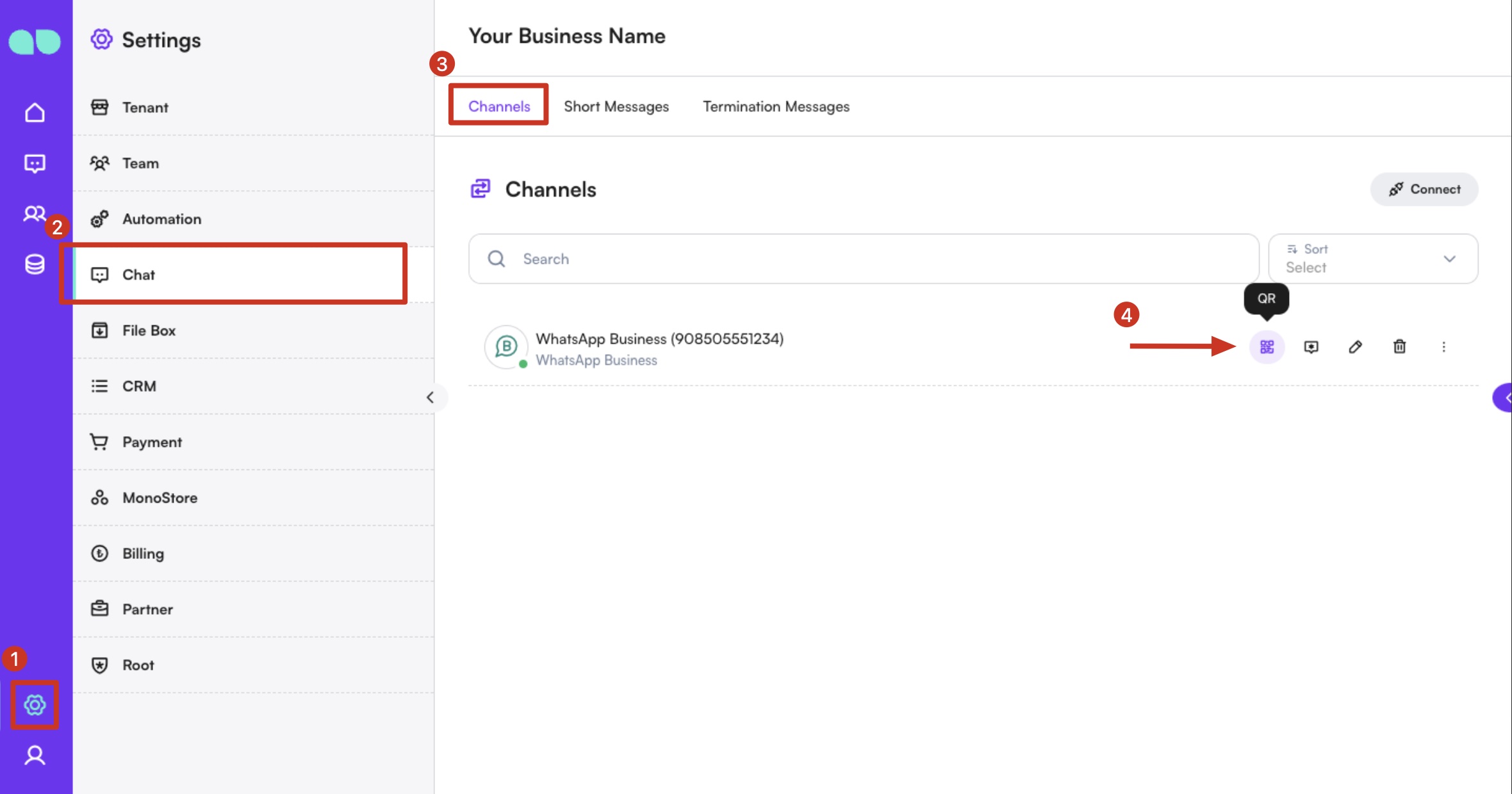
Step 1: Navigate to the Link Generator
To create a QR code or a click-to-chat link, navigate to Settings > Chat > Channels and find the link generator button next to your channel.
Step 2: Generate a custom link
Create a Custom QR Code
Generate a QR code for your WhatsApp Business API, Instagram, or other messaging channels and share it through various platforms. In the link generator drawer, select the QR code tab. You can create a pre-written message that will automatically populate when someone scans your QR code, making it easier for them to contact you. The QR code will automatically update whenever you change the message.
You may also choose to leave the message field empty, allowing users to start a conversation from scratch when they scan the QR code.
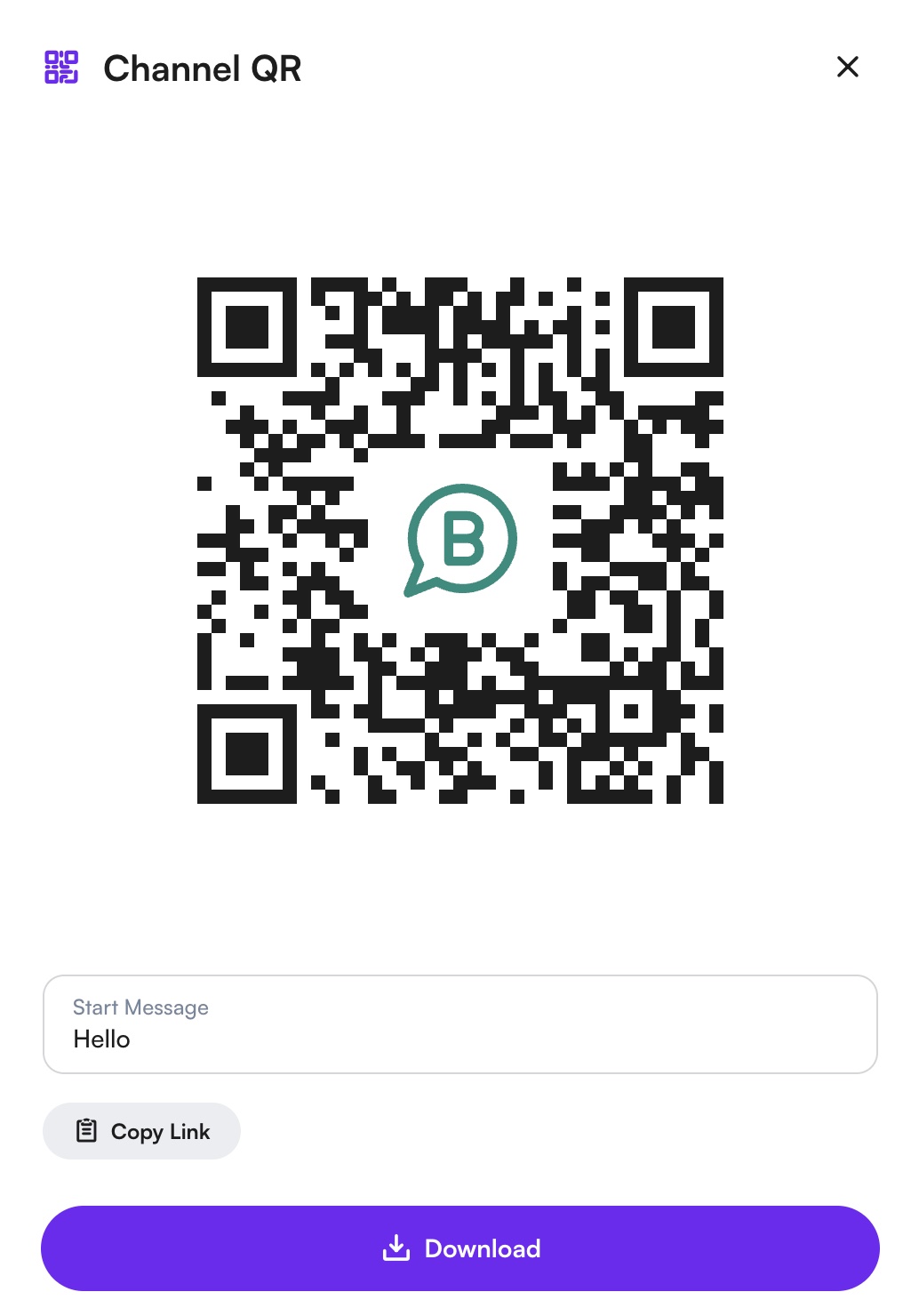
Once you are satisfied with your message, click the download button to download your QR code.
Create a Custom Click-to-Chat Link
Click-to-Chat links are a convenient way to invite people to start a conversation with you on MonoChat. In the qr generator drawer, you can write a pre-filled message that will appear automatically when someone clicks your chat link, making it easier for them to reach out.
If you prefer, you can leave the message field blank so users can start a conversation from scratch.
Once you’ve set your message (or left it empty), simply click the Copy Link button at the bottom of the drawer to copy your personalized WhatsApp link (e.g., https://api.whatsapp.com/).
Step 3: Promote Your Messaging Channels
Promote your messaging channels by embedding custom links and QR codes in your email signature, website, and social media profiles, and sharing them through marketing campaigns and newsletters. Regularly highlight your MonoChat channels on social media, in email campaigns, and on your website to drive more contacts and enhance your communication strategy.
Channel Webhooks
Channel webhooks forward a channel's raw events (incoming and outgoing messages, delivery reports, reactions, edits and more) to your own endpoint, so another system can follow the conversation in real time.
Where to find it: Settings › Chat › Channels, then ⋮ › Webhooks on the channel row. The item appears for connected WhatsApp Business API (Cloud and Gupshup), Instagram, Facebook Messenger, Telegram Bot, TikTok, Twilio SMS and Varan OTP channels, and only for users whose role allows reading channel webhooks.
The drawer lists the webhooks of the channel with their URL and subscribed topics.
Adding a webhook
- In the Webhooks drawer, click + (Create).
- Enter the URL that should receive the events.
- Under Webhook Headers, enter a Username and Password. MonoChat sends them as Basic Auth in the HTTP header of every request, so your endpoint can reject anything else.
- Under Webhook Topics, keep the topics you need. All topics the channel supports are selected by default.
- Click Save.
Use the pencil icon to change a webhook and the trash icon to delete it. Your endpoint can filter on the topic field of each request body.
| Topic | Sent when | Channels |
|---|---|---|
MESSAGE_INCOMING | The customer sends a message. | All listed channels except Varan OTP |
MESSAGE_OUTGOING | A message is sent from the channel. | WhatsApp Cloud, Instagram, Messenger, TikTok, Twilio SMS |
MESSAGE_ACK | A sent message's delivery status changes. | All listed channels |
CHANNEL_ACK | The channel's connection, activity or configuration status changes. | All listed channels |
MESSAGE_REACTION | A reaction is added to or removed from a message. | WhatsApp Cloud and Gupshup, Instagram, Messenger, Telegram |
MESSAGE_EDIT | The customer edits a message they already sent. | WhatsApp Cloud |
FEED | Posts and stories change. | Instagram, Messenger |
REACTION | Likes and reactions on posts and comments. | Messenger |
LEADGEN | A lead ad form is submitted. | Messenger |
PROVIDER_EVENT | A technical event comes from the provider. | WhatsApp Cloud and Gupshup, Twilio SMS |
CALL_EVENT | A voice or video call changes status. | WhatsApp Cloud |
MonoChat's own webhook, the one that keeps the channel working, is not shown and cannot be changed or deleted here.
Managing Channels
- View: To view the details of a connected channel, click on the channel name in the list.
- Edit: To edit the configuration of a channel, click on the edit icon next to the channel name. Make your changes and save.
- Delete: To remove a channel, click on the trash icon next to the channel name. Confirm the deletion when prompted.
- More actions (⋮): Depending on the channel type, the menu on a connected channel holds Template Messages, Flows, Inbox Settings, Profile Settings, Webhooks, Sync History Message / Sync History Contact (only during the first 24 hours after connecting) and, for Messages API channels, Documentation.
Best Practices
- Integration: Ensure that each channel is properly integrated and authorized to avoid any disruptions in communication.
- Redundancy: Consider adding multiple instances of critical channels to ensure redundancy and continuous availability.
- Monitoring: Regularly monitor the performance and status of each channel to quickly address any issues that may arise.
By utilizing the Channels feature, businesses can efficiently manage their customer communications across multiple platforms, enhancing their reach and responsiveness on the MonoChat platform.